

- 31,013

- a baby, candy, it's like taking.
- TexRex72
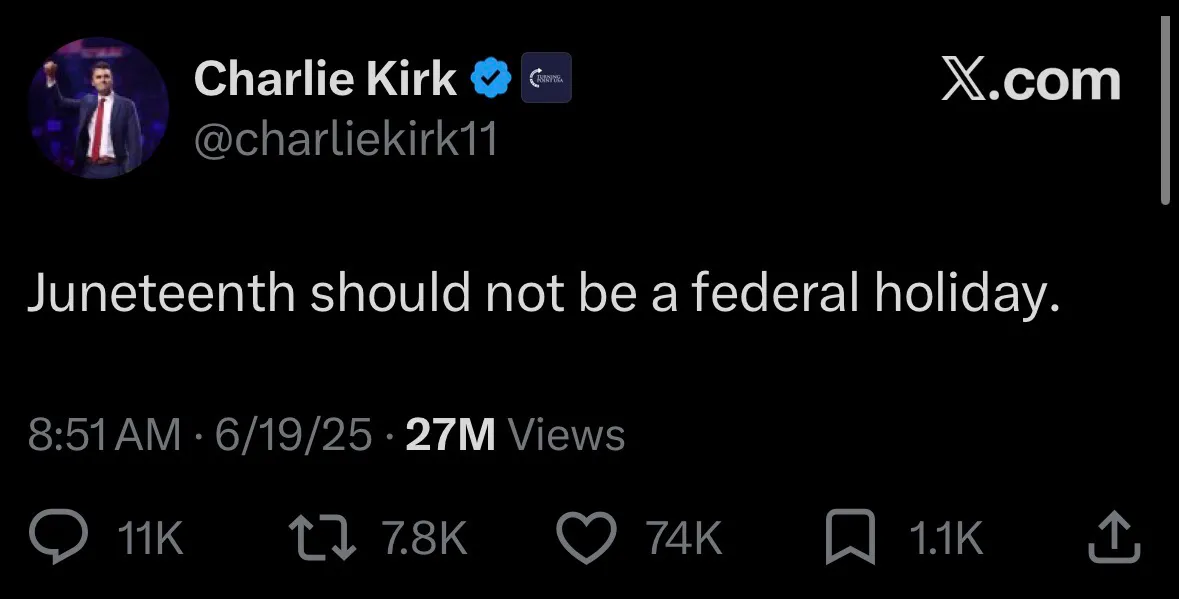
Juneteenth doesn't celebrate the end of chattel slavery in the United States. That didn't come about until 1866 with the Reconstruction Treaties when sovereign tribes not affected by the December 6, 1865 ratification of the Thirteenth Amendment to the United States Constitution were compelled through legal means to abandon the convention. Juneteenth celebrates a final blow to the Confederacy when Union General Gordon Granger rode into Galveston, TX on June 19, 1865 to enforce the Emancipation Proclamation two weeks after Confederate General Edmund Kirby Smith's surrender. Though slavery persisted in Union border states (the Emancipation Proclamation was a war powers act by President Lincoln which could not be enforced absent a force hostile to the Union) until December 6, the final enforcement of the Emancipation Proclamation and substantive defeat of the Confederacy marks a major turn against the convention of chattel slavery, and of course ratification of the Thirteenth Amendment required participation of Southern states.
So why is there conservative opposition to recognition of it? I mean even though the act to recognize it as a federal holiday sailed through a unanimous Senate, there was a speedbump in the House consisting of 14 Republicans (against 415 representatives from both parties) that voted against it. I think that boils down to it being a major victory against a conservative objective. Conservatives sought to conserve (indeed spread, as secession was a fundamental part of the push to expand the slave trade westward) a traditional, racial and economic hierarchy against abolition. And you better believe I think it's hilarious that Republicans are keen to point out that the South was a Democratic stronghold even as they defend slavery as being a product of the times and existing elsewhere in the world long after abolition in the United States.
Anyway I think there's a corollary with Pride, though what's being conserved is social, religious and familial hierarchy. Of course Pride isn't simply a celebration of homosexuality. The reason it's observed (notably not recognized federally like Juneteenth) throughout June is a number of significant social and legal victories in June (the Stonewall riots against state-sanctioned violence, Supreme Court decisions in Lawrence v. Texas which criminalized same-sex sexual relations by consenting adults, US v. Windsor which struck down parts of the federal Defense of Marriage Act allowing the federal government to deny benefits to those in legal same-sex marriages and Obergefell v. Hodges which struck down state laws and constitutional amendments prohibiting same-sex marriage) as well as memorials to those murdered in hate crimes like the Pulse nightclub shooting (49 killed) and the UpStairs Lounge arson in New Orleans in 1973 (32 killed) which authorities and the public ignored and even mocked because homosexuality was criminalized at the time.
Last edited:


