Failures of Motorsports - Car Designs, Team Mistakes and More

  • Thread starter Thread starter Panoz
  • 566 comments
  • 152,093 views
Last edited:
Very topical, considering that I was just reading about how there's supposedly been notable progress in letting Andretti/Cadillac into F1 for 2026. That is, unless the article mentions that exact development...
The article is from October 2023.

Topical, but a bit harsh I feel, considering half of those teams won a race at least.

Funny you should mention Reynard, their stillborn F1 design of the early-1990s begat both a success (the Benetton B194, correct me if I'm wrong) and a failure (the Pacific PR01), the latter racked up only 7 starts out of a possible 32 (none in the last 10 races) and no finishes in 1994. Bertrand Gachot actually declared he was glad to never have to drive the PR01 again after the inevitable double-DNQ in Adelaide.

Only at the season-opener in Brazil did a Pacific qualify on merit in 1994, inevitably in Gachot's hands.

Gachot was guaranteed to qualify in Imola thanks to Rubens Barrichello's accident. Paul Belmondo respectfully didn't take the late Roland Ratzenberger's place on the grid.

Both drivers were guaranteed to qualify in Monaco after Williams only ran Damon Hill and Simtek ran only David Brabham and Sauber withdrew after Karl Wendlinger's accident.

Both drivers were guaranteed to qualify in Spain after Sauber ran only Heinz-Harald Frentzen and Andrea Montermini crashed his Simtek and broke his ankles.

Gachot was guaranteed to qualify in Canada after Simtek again only ran one car for Brabham. To show just how little actual racing Gachot and Belmondo got to do that year, Belmondo covered the most distance in a race either driver would manage all season at Monaco, lasting 53 laps before retiring due to being physically fatigued!

Truth be told, the car was originally designed for 1993 with Michael Bartels (and Gachot? Or possibly David Coulthard since he drove for Pacific in F3000 that year?) driving but a lack of finance meant their entry was delayed until 1994 so the car was already a year out of date before it had even raced (and possibly even older as the Reynard F1 car was intended for 1992).

Reynard was also involved in the construction of the unraced DAMS F1 car.
On a minor note, regarding the Pacific team's 1995 launch, how long does it take to open a bottle of champagne?
 
Formula Acceleration 1
6546234-9873258-1280x720.jpg

It ran for one season in 2014.

For all intents and purposes, it was an attempt to resurrect A1GP as it utilised the Lola-Zytek B05/52 that had been used in the first three seasons of the latter series.

The difference was the drivers weren't required to drive for the team representing their nation (for instance, Spaniard Dani Clos drove for the UK), although China was the only nation not to have a representative all season.

Nine meetings were planned but only five took place, largely due to lack of entrants, with grid numbers peaking at 14 for the final meeting at Assen.

12 Nations took part in all, but only 10 contested the full season as Venezuela dropped out ahead of Assen, the UK took their place and notably secured a fastest lap and a 2nd to take 10th in the standings.

The season was a straight fight between the Netherlands (Nigel Melker) and Italy (Mirko Bortolotti) with Melker winning the driver's title by default after Bortolotti withdrew. The pair won 8 of the 10 rounds between them. The Netherlands took the Team's honours.

The only other winners were Sweden with Felix Rosenqvist doing the double at Monza.

The series merged with Auto GP for 2015 as that series was also using the Lola B05/52 chassis. But that series also suffered from lack of entries and was canned before merging with the BOSS GP Series in 2016.
 
Last edited:
The event last season was punctuated by tyre issues on the kerbs forcing mandated pitstops (USA 2005 eat your heart out)​
The 2023 Qatar Grand Prix certainly threatened to be one.
 
Nissan had an unsuccessful attempt in Group A Rallying with the Sunny GTI-R, contesting just 9 events between 1991 and 1992 with different drivers, including veteran Stig Blomqvist and a young Tommi Mäkinen, the car was relatively competitive but had a few flaws mostly being the uncompetitive Dunlop tyres, the awkwardly fitted intercooler which made the engine prone to overheating (to which they tried to fix it by fitting the light pod most of the times) and issues between Nissan Japan and Nissan Motorsport Europe.

The Sunny's best result was 3rd at the 1992 Rally Sweden, at the end of the year Nissan pulled the plug on the project, while it did not succeed in Group A, it did in Group N, winning the title in 1992 with Grégoire de Mevius at the wheel.
 
Last edited:
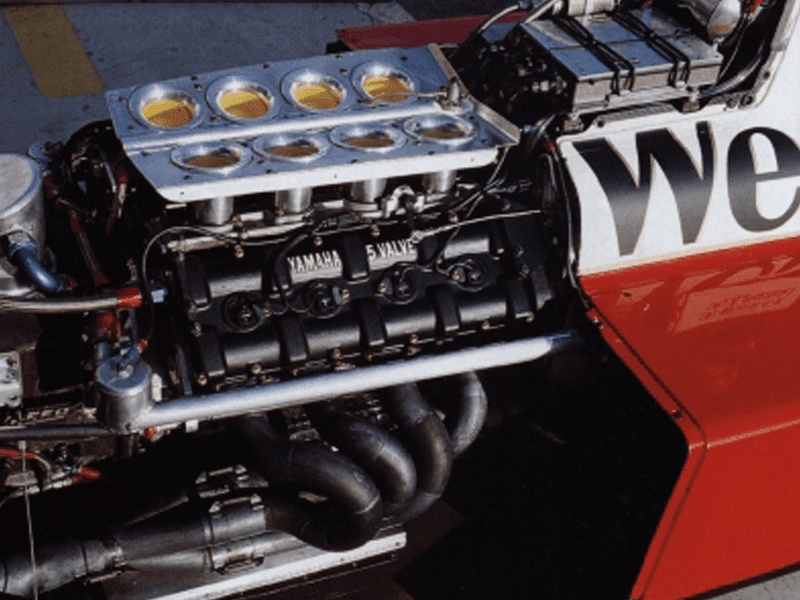
What about Yamaha as an F1 engine supplier? Especially 1989 with Zakspeed, 2 DNFs, 30 DNPQs, one destroyed single seater career of a future DTM legend, one lost sponsor that doesn't reappear until 1997 thus precipitating in the team's demise despite briefly appearing in pre-season testing for 1990 and Yamaha taking a year out.

Zakspeed is an interesting case. They certainly failed in F1 with their own turbo engines (only a single twice-lapped 5th place to show for 4 seasons worth of trying) but the Yamaha OX88 engine they used in 1989 really let them down.


Mind you, Yamaha engines only ever yielded two podiums in 7 years of trying from 1991-1997, including Damon Hill's near-miss at Hungary in 1997.

(I will admit my main influence was F1/GP Rejects)
 
Last edited:
The Opel Calibra 4x4 Turbo Group A Rally Car

It was the first ever rally car with an active differential. Vauxhall/Opel initially entered the Astra Mk2/Kadett E GTE as their Group A car. It was front wheel drive and although it proved it could cut it against the BMW M3's entered by Prodrive and the Ford Serria RS Cosworth both rear wheel drive by the time Lancia and Mazda had got their act together with the Delta and 323F both 4WD, something with a Turbo and 4WD was required. This was initial going to be the Cavalier Mk3. A car was produced to Group A specification and extensively tested. However, there was a change of mind and the Cavalier Mk3 Group A rally car project was scrapped.

Vauxhall/Opel approached Motorsport Development of Milton Keynes to transform the Calibra 4x4 Turbo into a Group A car. The car was 290bhp via an Xtrac/MSD 6 speed gearbox and variable torque split 4WD system. Michelin also worked closely with the team developing tyres. Brakes were AP ventilated 4 pot disc brakes all around.Motorsport Development advised Vauxhall/Opel that the car needed a big wing, wide arches and a large turbo and presented this in a large dossier to Vauxhall/Opel. However, Vauxhall/Opel said this wasn't required and the car was extremely aero dynamic and a decent size with a nice small Turbo that cut weight and was 4x4.

The Turbo however was to have been the cars downfall. Vauxhall/Opel had little experience of Turbo's at the time and wanted to find a way to reduce the Turbo lag. They came up with the idea of putting the Turbo nearer the exhaust manifold as the nearer it is the less lag there is. So they located the Turbo right inside the manifold, rather than behind it! They were correct about this reducing Turbo lag, however they forgot that the nearer the Turbo is to the exhaust manifold the hotter it will get. This caused massive problems with the Turbo and effected the engines performance and reliability. Power was suggested to be in the region of 290bhp.The car should have made it debut on the Vauxhall Sport International Rally starting from Chester on 21st March 1992 with a full development programme through the year leading to a Group A homologation and full international competiton in 1993.

The car's first and, as it turned out, only event as a works car on the World Rally scene was the 1993 Swedish Rally. An event presumably chosen as it was cool and the Turbo should not have any overheating issues. How wrong could they be though. The car was driven at this event by rallying legend Stig Blomqvist. Stage times were looking good and the car was in the top 10. Which was acceptable for a new car. For the first 20 stages the car ran like clockwork. After Stage 20 Stig informed his mechanics at Service that there was a problem with the head gasket. His mechanics checked everything but could not find any issues. They asked Stig how he knew this and he replied he could smell it. At that point his mechanics declared him mad and sent him on his way to Stage 21. On stage 21 Stig and the Calibra retired with a blown head gasket! After Sweden the car was never seen as a works car again.
 
Last edited:
North American Touring Car Championship - 1996 to 1997. Most races in 1996 had 11 or 12 entrants per race and the 1997 season wasn't much better. The series was ended after the 1997 season due to lack of interest.

The North American Touring Car Championship

Yes, even America embraced the Supertouring regs that were all the rage in the 1990s, albeit briefly. Funded by Jerry Forsythe and run from Tampa by Roger Elliott (BTCC boss Alan Gow also providing input), the series kicked off in 1996 as a support series to the road and street course rounds of the CART Series.


Right away, interest from teams and manufacturers was lacking, only 10 cars turned up for the first meeting of the season at Lime Rock Park and only Chrysler was really properly committed via their Dodge brand. Although 8 different manufacturers took part in at least one meeting in that first season, only 4 were works entries and the number of entries all season peaked at 12. Not surprisingly, the series was dominated by American drivers with only Britain's Peter Hardman denying them a clean sweep of wins in Race 2 at Toronto. The most notable entries that year were CART stalwarts PacWest Racing running the late Mark Donohue's son David and ex-Indycar driver Dominic Dobson in Dodge Stratus' and Mario Andretti's other son Jeff in a Ford Mondeo but the title went to Randy Pobst in a Honda Accord.

The series survived into 1997 but, once again, never attracted more than 12 cars. There was even less interest from teams and manufacturers this time around, only 3 works teams and 7 different makes took part. At least there were more meetings (9 as opposed to 8) and more drivers took part (21 as opposed to 20 the previous year) and 6 of them did the full season (as opposed to just 4 in 1996) and the series was popular with fans. The title eventually went to Donohue, but if not for a disqualification at Detroit and missing the Portland rounds, Australian Touring Car ace Neil Crompton could have spoiled the party for the Americans as his 7 wins handsomely outnumbered everyone else and ensured a clean sweep of NATCC Manufacturer's titles for Honda. The only other notable competitor that year was South African lady driver Desire Wilson and for the reasons mentioned above, as well as Dodge pulling out at the end of 1997, the series did not continue into 1998 and folded.


Though, given the existence of NASCAR, any attempt at a different kind of tin-top series that wasn't already well and truly established in North America was likely doomed to failure right from the very beginning. At least the NATCC actually took off and lasted two whole seasons whereas the American TCR never got off the ground.
 
HKS entered a Mercedes CLK-Class as a GT500 entry in the 2002 All Japan Grand Touring Car Championship. The car only appeared in 5 of the 8 rounds. It failed to qualify at Fuji and Sugo, retired at Motegi and Mine and finally came 15th, four laps down, at Suzuka. Even the JLOC Lamborghini finished ahead on countback.
 
An estate version of the Subaru Imprezza raced in the Japanese Touring Car Championship in the mid-to late 90s.


The car raced in the 1996 and 1998 Seasons. It was run as a privateer effort and wasn't competitive. It only troubled the scorers 3 times, each time in the 1998 Season, largely due to the declining series' depleted grids.
 
Last edited:
Fails On Race Day?

How Ford had it, lost it then got it back.


undefined-1621031265935.jpg


Everybody loved supertouring. It was and arguably still is the most popular iteration of the British Touring Car Championship. But where did it come from and why? Well, the simple fact is that Group A was killed in Europe largely because of Formula Sierra - Ford's monstrous RS500 blew away all the minor competition for Class A honours. Rover and its Vitesse disappeared, Mike O'Brien's Holden Commodore was fighting Class B BMWs and Chris Hodgetts' Toyota Supra didn't cut the mustard. We won't even pretend that the Maserati Biturbo had a chance. Ford was, at that time, unquestionably the most successful manufacturer in BTCC history but after Robb Gravett became the only driver to actually win the title in a Sierra Cosworth, in 1990, everything changed.

Rob-Gravett-in-hos-Trakstar-Cosworth-RS500-leading-Andy-Rouse-in-the-1990-Birmingham-Superprix.jpg


The 190mph Sierra Cosworth did at least finish on a high in 1990.

The two-litre formula appeared in that transitional year to become the sole class for 1991. Gravett's Trakstar team ran on what can generously be called a shoestring budget and were very close to going out of business during his title-winning year despite their success. It's important to note that at this time the idea of a "works" team as we would know it today was not yet a thing. Given that Andy Rouse immediately changed to Toyotas for 1991, Ford's representation in the series was a ramshackle team and a hastily-prepared Sierra Sapphire hopelessly unready for the new era of touring car racing. Gravett, clearly a top driver given that he had beaten the legendary Rouse in about-equal machinery, had a torrid year and was 11th in the championship and classified out of the points in six races that year.

5226612956_a01a3730ed_b.jpg


A forunate but heartwarming 2nd at Brands Hatch late in the season spared the champion's blushes.

It was immediately apparent that BMW, Toyota and Vauxhall were the three to beat and Trakstar went bust. In 1992 a detuned, privately-entered Sierra made a few token appearances to no fanfare but Ford were working hard in the background. Their replacement for the Sierra, the "world car" Mondeo was almost ready and 1993 would see Ford return to the fold as a works team; Andy Rouse was back and the Mondeo went through extensive testing to make sure the Blue Oval was going to return to the front of the field. So much testing that the team even tested rear-wheel and four-wheel drive versions of the Mondeo, which would have been a unique combination; a car racing with a drivetrain unavailable on its road-going equivalent.

1993 was a near-clean sweep for AC Schnitzer and BMW but at the eighth race out of seventeen, Andy Rouse and his Mondeos appeared. They were immediately on the pace with New Zealand star Paul Radisich scoring points on his debut, a podium in his second race and ended the final six races with three wins and three 2nds. Having missed the first seven races, he actually finished 3rd in the championship, so strong was the Mondeo's arrival. It was all set up for Radisich, the young gun, and Rouse, the wily driver-manager, to make a serious challenge in 1994.

ford-mondeo-20-si-btcc-1993-326640.jpg


Radisich began his five-year association with Ford in competitive and convincing style.

Then Alfa Romeo appeared. And so did aerodynamics. Everybody was caught out by the Alfa Romeo 155's conspicuous and deliberate aerodynamics package and despite crying foul and Alfa briefly being excluded, Gabriele Tarquini crushed the opposition and aero was here to stay, changing the course of touring cars forever. Radisich and the Mondeo were again competitive with two wins and seven near-miss 2nd places but a run of five no-scores towards the end of the year saw his expected silver medal stolen by Alain Menu and the nascent Renault Laguna.

It should also be pointed out that Paul Radisich actually won the 1993 and 1994 Touring Car World Cup against the best of the best, giving him the fair claim to being a double world champion. Ford did have something but with such a cataclysmic shift in the dynamics of touring car building, could they keep it going?

1.jpg


Alfa Romeo leading the way with the rest playing catch-up.

In 1995 all the cars featured rear spoilers and front diffusers; the Mondeo slipped behind the pack. The Mondeo was still competitive on paper but a common sight in 1995 was the Fords failing towards the latter half of the race. Radisich and new teammate Kelvin Burt held on as long as they could but their Mondeo's cross appeared not long from the chequered flag - tyre wear. The effect of the aerodynamics and the Mondeo's heavier V6 engine (unique amongst the grid) shredded their tyres and destroyed their race pace. A win apiece was a good showing but it was obvious that Ford were going backwards. Radisich suffered even more ignominy with nine no-scores from the final ten races.

1996 was even worse. Under West Surrey Racing supervision the Mondeo hatchback arrived and was, quite simply, dreadful. A fairly unknown but talented Formula Ford champion called Steve Robertson, yes that Steve Robertson of Kimi Raikkönen's manager fame, partnered Radisich this time and at the very first race the two cars hit each other from a lowly mid-teenth race position as the top image in this post shows. Radisich wrestled as much as he could out of the car but 13th and just 27 points said it all. Robertson scored just two points and finished 20th even behind three privateers. This one season driving for Ford in the BTCC effectively killed his driving career.

1997 was Radisich's last year with the team and he was partnered by 1991 champion Will Hoy. A newly-revised Mondeo was better than 1996 but the nature of the championship had changed so much from Hoy's title winning year. As mentioned in the Peugeot retrospective several pages back, by this point serious players from Formula One were underwriting huge financial outlays to get the best international stars. In a field with Williams Renault and TWR Volvo, and a grid with Biela, Menu, Tarquini, Winkelhock and Rydell, the plucky Pug and feisty Ford scrapped for the minor places. Radisich finished 13th again but with more points whilst Hoy scored 27 points. At least Ford beat Vauxhall in the Teams Championship, Vauxhall having their own embarrassing year.

FTqizTqXwAEjrFt.jpg


TOCA Touring Car Championship will forever immortalise this particular Mondeo.

After five years fighting for Blue Oval honours, Radisich had had enough and left for Peugeot. One New Zealander out, one New Zealander in as New Zealander team manager Dick Bennetts recruited Craig Baird to partner Will Hoy for what would be an eventful 1998. Baird flattered to deceive but Hoy, a perennially popular figure in the paddock, had an Indian summer with a much more competitive season.

Whereas the heavy V6 compromised tyre life, in wet conditions the heavier front-end of the car was, apparently, to the car's major benefit. At just the fourth race at Silverstone, Hoy cruised to a hugely celebrated win for what was now an unfancied car. The rain was to his and the Mondeo's advantage and where others slipped off, hit each other or put on the wrong tyres, Hoy kept his cool and aced what would be his final BTCC victory. Mid-season at Donington, Nigel Mansell was drafted in for some much needed publicity and although his exploits are not as correctly remembered as they should be, he was on the pace and leading at another wet race at Donington Park. Baird himself, left out in the cold whenever Mansell drove, led convincingly at Knockhill in a rainstorm until a poor tyre choice saw him drop back down the field.

Baird and Mansell didn't make an impact in the championship table but Hoy finished 10th, the first top 10 finish for a Ford driver in three years and actually finished ahead of Gianni Morbidelli, who was the champion's teammate.

screenshot-2018-12-01-at-09-42-45.png

Will_hoy_1998.png


Hoy finished his mainline driving career in style.

After so long in the doldrums, had Ford finally turned a corner? It was not for West Surrey Racing to find out. In a merry-go-round of who took over whose works contracts, WSR and Prodrive essentially swapped with WSR picking up Honda and the vastly experienced Prodrive taking over at Ford. Prodrive had more clout, more finance and for the first time in a long while, two serious front-runners - Alain Menu and Anthony Reid. Expectations were high but teething troubles with what was indeed a much more competitive car saw the drivers who had finished 2nd and 4th from 1998 finish 11th and 12th in 1999. Menu did take a well-deserved victory at Knockhill and there were rumours of a top car for 2000.

Prodrive's previously-mentioned financial clout meant that they were one of just three teams to make the grid for the new millennium along with Honda and Vauxhall. With such less competition and more points up for grabs, this year was win or bust for Ford. With Rickard Rydell as a third driver, it was arguably the most talented peak driver line-up in touring car history.

Ford ended up making it look easy. Honda and Vauxhall fell over themselves trying to not win. It would be harsh to say that Ford went from killing Group A to killing supertouring but it is remarkable how they came good right at the end. 2000 was a three-way dance between Ford's own drivers with all three going into the final round with a chance of winning. In the end, Menu eked out Reid on a cruel dropped scores rule.

sddefault.jpg


The frequent and admittedly impressive sight in 2000.

It was not Ford's fault that supertouring ended. It was already known that 2001 would be a scaled-back and stripped-down championship coupled with turmoil behind the scenes between TOCA and Octagon. But what is undeniable is that when they had their best chance, they absolutely took it.
 
Last edited:
Mike O'Brien's Holden Commodore
Knew there was a Commodore briefly raced in Japan around the same time. But I had absolutely no idea until now that there was ever one entered in BTCC. Wonder what chassis it was, I assume it was more than likely an ex Holden Dealer Team car. Maybe one that they raced in the Spa 24hr?

Also, it's very interesting the similairities with ATCC and BTTC, with the Sierra and then the GT-R dominating things. Resulting in sweeping new regulations to essentially ban them. It took us a two more years to move on from Group A though.
 
Knew there was a Commodore briefly raced in Japan around the same time. But I had absolutely no idea until now that there was ever one entered in BTCC. Wonder what chassis it was, I assume it was more than likely an ex Holden Dealer Team car. Maybe one that they raced in the Spa 24hr?
There were a couple of VK Commodores competing the 1987 WTCC. I actually met one of the guys on who were on the team running the cars over there, at the Adelaide 500 one year. We both had seats at Turn 8, so I got to hear some great stories from the Group A era over the 4 days.
 
I had absolutely no idea until now that there was ever one entered in BTCC. Wonder what chassis it was, I assume it was more than likely an ex Holden Dealer Team car.
There were two; in 1987 he drove a VK SS and in 1988 a VL SS.

8350772008_6fd67a39c4_b.jpg


As I said, it generally ran at the back of Class A closer to the M3s but in 1987 the BTCC's best was competing in the World series so the lesser cars had their final day in the sun - Tim Harvey won Class A in an ancient Rover Vitesse and O'Brien's Commodore did actually win at Snetterton that year, a power circuit that would have suited its big engine.

ADR ran the car but other than Alan Docking himself being Australian, I don't know whom they got it from.
 
Last edited:
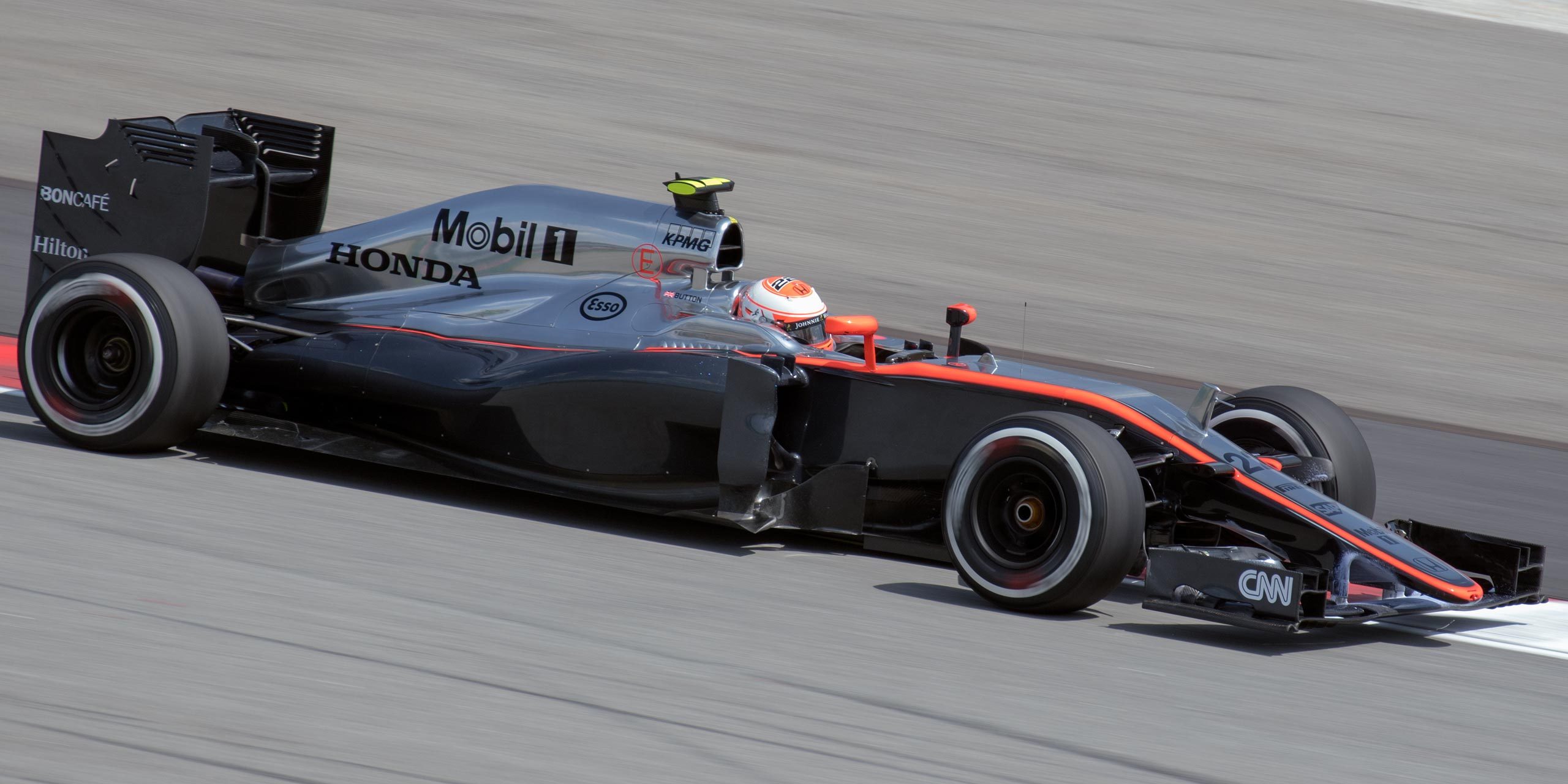
Jenson_Button_2015_Malaysia_FP2_2.jpg


McLaren suffered one of the team's worst seasons in their storied history due to reliability issues and power output on the new Honda powerplants.
Now Aston Martin are going through similar...
 
Osamu Kawashima's recent BTCC outing at Silverstone.

He was 3 seconds off the pace, 2 laps, then 3 laps down and temporarily deprived Aiden Moffat of his Race 1 victory by forcing Aiden to break his final track limits warning while being lapped.

Then again, he was the series' oldest debutant since Mark Blundell in 2019 and the oldest since George "Doc" Shepherd in its inaugural season back in 1958.

The fact that Ricky Collard, whom Kawashima replaced, got his seat back for the next meeting speaks volumes....
 
Back