Traction Variation

  • Thread starter Thread starter NSX-R
  • 24 comments
  • 1,185 views
Messages
813
I am a little frustrated with poor traction when accelerating! Actually, the HUGE difference between tractions of close "relatives".

For example, I have a 343 horsepower RX7 Type R, which has relative poor traction than the RX7 RS (345 horsepower). RS is superior and younger than Type R, but traction is ultimately better everywhere! RS only has to smoke on 1st gear going WOT, the Type R goes until 3rd gear! I had to hold back the throttle thus not using all the power!

They both have the same chassis, which is the most important part of traction. So why? Is it the same in RL? :nervous:

And also, Nismo Z33 Z-tune has 390 horsepower, and has so much better traction on the straight? Is this realistic?

Thanks!
 
NSX-R
I am a little frustrated with poor traction when accelerating! Actually, the HUGE difference between tractions of close "relatives".

For example, I have a 343 horsepower RX7 Type R, which has relative poor traction than the RX7 RS (345 horsepower). RS is superior and younger than Type R, but traction is ultimately better everywhere! RS only has to smoke on 1st gear going WOT, the Type R goes until 3rd gear! I had to hold back the throttle thus not using all the power!

They both have the same chassis, which is the most important part of traction. So why? Is it the same in RL? :nervous:

And also, Nismo Z33 Z-tune has 390 horsepower, and has so much better traction on the straight? Is this realistic?

Thanks!

While a cars chassis is a factor in traction, it is not the most important part of it. I would argue that the single most important part of traction is the one thing that connects your car to the road; the tyres.

You also need to take into account how well the tyres are held in contact with the road surface, which is a factor controlled mainly by the suspension set-up and also how the power is delivered to the tyres, which is controlled by your gear ratios.

In other words before you need to take all of these factors into account when comparing traction levels, even between two cars of a similar nature.

In regard to how realistic (in comparison to the real world) I have done a number of 0 - 100 - 0 (mph) tests in GT4 and compared the results to the same tests carried out by Autocar magazine in the UK. You may be surprised by how close GT4 is to these figures.

You can find the full details of the tests over in the tuning and settings section, in a thread called GT4 & Brakes (or just follow the link in my sig).

The problem I find with GT4 is that the throttle is very, very sensitive and as such it is very easy to overpower the tyres off the line.

As far as giving a car full throttle off the line, its no big surprise that you are going to smoke the tyres, 1st gear ratios are set (in both GT4 and RL) to allow you to accelerate quickly. If I give my wifes Fiat full throttle and dump the clutch that will fry the front tyres with only 70 bhp; if you throw in a close set of low gear ratios and 300+ bhp you can get this occuring in the lower gears.

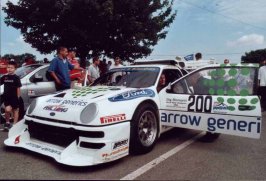
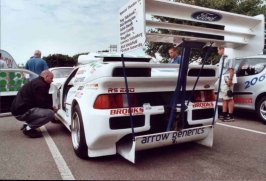
I once saw a Pikes Peak Ford RS200e with 840bhp spin the tyres (which were racing slicks) in all gears on warm tarmac (pic of the car below), tyres can only take so much and if you throw to much at them they will just let go. Gentle but progressive throttle application with the best tyres you can go for and a good set-up are all required to lay down a lot of power, both in GT4 and the real world.

Hope this helps.

Regards

Scaff
 

Attachments

  • Pikes Peak RS200e (840bhp) Front.JPG
    Pikes Peak RS200e (840bhp) Front.JPG
    46.8 KB · Views: 70
  • Pikes Peak RS200e (840bhp) Rear.JPG
    Pikes Peak RS200e (840bhp) Rear.JPG
    44.9 KB · Views: 54
Quick questions: does spring rate matter?
Don't they have the same gear ratios?

They both have been tuned, and they have both damping 6/8 frond and rear with N2s.
 
NSX-R
Quick questions: does spring rate matter?
Don't they have the same gear ratios?

They both have been tuned, and they have both damping 6/8 frond and rear with N2s.

Yes spring rate does matter, but not as much as the fact that you are running N2's.

I can't tell you if they have the same gear ratios, have you changed the gearbox or adjusted the settings. If they still have the stock 'box you can still view the gera ratio graph in the adjustments screen, have a quick look.
 
Yep, RS's 5th is a little longer, by a small margin. I don't think it matters because I don't usually go that fast.

Also, lateral Gs are totally different too. Type R is the only car I can throttle-slide with, and RS is stable as hell, but when it losses control, there is no way to bring it back!
 
I get the feeling that the automatic clutch action also promotes wheelspin from a standing start, because the clutch only seems to engage at certain revs and a certain throttle position, meaning there is a fine line between sitting on the start line watching the engine slowly revving and a ticking clock, but going nowhere, and sitting on the start line watching the engine headbutt the limiter and a ticking clock, but going nowhere but creating lots of white smoke.

I don't see how else they could have modelled it, to be honest, except by allowing you to select neutral, then rev, then engage the clutch when you select a gear, but even that does not make it easy. I must also say that some cars seem to exhibit barely believable levels of traction... the Ford GT always surprises me in that respect.
 
NSX-R
Yep, RS's 5th is a little longer, by a small margin. I don't think it matters because I don't usually go that fast.

Also, lateral Gs are totally different too. Type R is the only car I can throttle-slide with, and RS is stable as hell, but when it losses control, there is no way to bring it back!

Sounds like it could be your suspension settings, however you should address this one over in the Settings & Tuneing sections, maybe a mod would be kind enough to move this thread over (or I believe you can do it yourself), post your current settings up and wait for feedback and suggestions.

Im not a regular user of RX7's, but I'm sure you will find more that a few people who would be willing to suggest setups.
 
Alfaholic
I get the feeling that the automatic clutch action also promotes wheelspin from a standing start, because the clutch only seems to engage at certain revs and a certain throttle position, meaning there is a fine line between sitting on the start line watching the engine slowly revving and a ticking clock, but going nowhere, and sitting on the start line watching the engine headbutt the limiter and a ticking clock, but going nowhere but creating lots of white smoke.

I don't see how else they could have modelled it, to be honest, except by allowing you to select neutral, then rev, then engage the clutch when you select a gear, but even that does not make it easy. I must also say that some cars seem to exhibit barely believable levels of traction... the Ford GT always surprises me in that respect.

Quite agree, one of the things I thought of when running the 0-100-0 tests, and I also would struggle to see how else they would model this without a dedicated clutch pedal that allowed you to slip the clutch if you wished. Then you get into the issue of 'feel' and a force feedback clutch pedal would be an interesting piece of kit.

When running the tests the Ford GT (on N2 and N3s) quite surprised me; for all the people who say that PD got the car wrong, it is very close to is real world figures in quite a few areas.
 
Why couldn't you lose control on the start if you accelerate hard?
 
As far as addressing the RX-7 problem the main difference in wheel spin is TORQUE. Forget horsepower, that is just how quick the engine revs and with how much force. Torque is how much that horsepower is resistant to resistance. For example, two identical cars with the same horsepower, (we'll say 300bhp). But one has 300lb-ft torque and the other only has 200lb-ft torque. The cars are set to drag race up a strait 1/4 mile with a 20% grade (that's very steep btw) These cars run almost identical 1/4 mile times on level ground so you'd think they'd be near equal now right? WRONG the car with 200lb-ft will be left in the dust because it can't pull the hill as well as the more torquey car. This also means that it will be easier to wheelspin the car with 300lb-ft.

In other words the reason the RS handles like it does is because it lacks torque, it's bogging down (doesn't have the power) wheras the Type R is not. If you could keep the Type R from wheelspining it would accelerate quicker. That's also why you can drift the Type R. It can get wheelspin during a corner Wheras the RS can only get oversteer.
 
Since you can't do anything about the tire contact patch, spring rates are the biggest controllable factor between two otherwise equal cars. Sitffer cars are much better around the track, but won't get off the line as fast as a car that's just a tad bit softer.

NSX-R
Why couldn't you lose control on the start if you accelerate hard?

Like in NFS? :D It'd be a nice touch, but then PD would have to model differences in half-shaft lengths leading to torque differences between wheels across an open differential, as well as body twisting... blah blah blah...
 
rsmithdrift
horsepower, that is just how quick the engine revs and with how much force. Torque is how much that horsepower is resistant to resistance

Great description, thats the first time ive ever actually heard someone split the difference between Kw and torque, nice job.
 
niky
...PD would have to model differences in half-shaft lengths leading to torque differences between wheels across an open differential, as well as body twisting... blah blah blah...

I kind of get the impression from the FF cars that they have at least tried to do this. When I wasted my time giving 400bhp to a 147 GTA and Focus RS, they both displayed torque steer under acceleration (the car tries to pull to one side or another under acceleration). I believe torque steer can be caused by having the halfshafts unequal in length and not horizontal. Also I have a theory that the "power oversteer" capabilities exhibited by the powerful FF cars with LSDs (again the GTA and Focus) are caused by overenthusiastic modelling of the LSD function, since when I get power oversteer in an FF car I get wheelspin on the inside front wheel at the same time. This suggests to me that GT4 is modelling the LSD sending lots of torque to the outside front wheel (the one with grip), so the car is driving forward on one wheel only, which would tend to make it pull to one side, which would be towards the inside of the corner. At the same time, the rear has little grip. Also, FR and RR cars without an LSD also can spin the inside wheel and lose drive, as would be expected, when turning under power. This all suggests that PD has at least modelled torque to each driven wheel individually according to conditions, which should allow one to experience a loss of control from a standing start.
 
Alfaholic
Also, FR and RR cars without an LSD also can spin the inside wheel and lose drive, as would be expected, when turning under power. This all suggests that PD has at least modelled torque to each driven wheel individually according to conditions, which should allow one to experience a loss of control from a standing start.

Yeah, that's called peg legging. Happens all the time in this game with open diff. cars. Go drive you're 240z with the standard diff, then turn and get wheelspin. Notice how only one wheel spins. Heres the LSD thread: https://www.gtplanet.net/forum/showthread.php?t=66142
 
NSX-R
For example, I have a 343 horsepower RX7 Type R, which has relative poor traction than the RX7 RS (345 horsepower). RS is superior and younger than Type R, but traction is ultimately better everywhere!

They both have the same chassis, which is the most important part of traction. So why? Is it the same in RL?

In short, yeah, the traction issues are probably similar. Like you said, the RS is a newer car. Mazda obviously must have made some changes to the car so that it had better traction. That change was reflected in the game.

That means the two cars are not exactly the same. Just look at the weights for different FD3S models. I've seen 1260kg, 1270kg, and 1280kg. I've also seen tuners on other boards create setups for the different models, like the Type R Bathurst R vs the newer Spirit R Type A. It's been said that each car benefits from having it's own setup. Sure, you can interchange setups(ex: Spirit R on Bathurst R) since the cars are similar, but using a specific setup intended for the car will yield better results.
 
good question i was wondering that myself. this is an interesting thread
 
There is also the chance that the Type R has wider tires.
 
Scaff
Yes spring rate does matter, .....
And don't forget to set the shocks accordingly, higher spring rate higher values for the shocks, lower spring rate lower values for the shocks.

PhM
 
rsmithdrift
As far as addressing the RX-7 problem the main difference in wheel spin is TORQUE. Forget horsepower, that is just how quick the engine revs and with how much force.
Exactly, Power = Torque * Revs. The only things that matter to figure out what force you'll get at the tire level are torque, gear ratios and wheel radius.

PhM
 
NSX-R
Quick questions: does spring rate matter?
Sorry, I just found that really funny...no offense :) Basically, the softer the spring rate, the more weight can transfer to over the rear tires since the back end gets lower. Also, the springs can absorb some of the initial shock of hitting the power, as opposed to the tires having to absorb all of it on its own with stiff springs. If you ever watch an old-style drag racer, you'll notice when it launches it sits way down onto its back tires. Of course, you can't just turn the rear spring rate way down when racing on a track, because then your handling goes to pot, but yes, the spring rate matters immensely :)
 
As for the differential modelling. What GT does model for FF cars is front wheel hop... that vibration you get when you're accelerating hard isn't torque steer, rather it's the drive shafts uncoiling as the car's weight shifts under acceleration.

So far as I've seen, PD hasn't modelled any car with stock LSDs. That's why wheels on the grass get you sideways in almost any car in the game.
 
stan394
ballast matters too

Yes!!!!!.......Did anyone even notice that post? Ballast also comes in very handy when trying to get off the line quickly, and more importantly, the weight distribution of the car is the key component to get off the line quickly, you notice that cars in RL that are mid or rear engined, take Porsche as an excellent example, cars like the 911 Carrera which have only 239KW (320hp), and weigh in around 1300kg - 1400kg, manage to get 0 - 100km/h in under 5 seconds. the extra weight over the rear wheels push the tyres into the road and make it harder for them to let loose and smoke up.
And this is why cars in GT4 like the NSX, MR-2, which are MR cars are so strong off the line and suffer from next to no wheelspin at all.
you may wonder why ff cars smoke up so much even little hp cars, its because under acceleration the car lifts its nose upwards which takes lots of load of the front tyres, which makes the front wheels with so little force keeping them on the road very easy to spin.

So if you are having trouble with wheelspin try adding 50kg of ballast at a time all to the rear of the car, just remember though, it will make the car less stable under hard braking.
 
Trying to work out the perfect amount of balast could be hard when trying to shorten 1/4 mile times... too little would result in wheelspin.. too much, and itll weigh the car down.
 
I've found with RWD cars with a lot of horsepower (over 800 or so), maximum ballast produces the fastest times. In the 400m, the traction off the line is the most important factor, but in a longer race (such as the 1000m), a balance between weight and traction has to be found.
 
Back