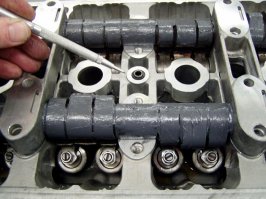
Because the more something weighs the more force is required to move it and stop it moving, so lighter vales and rods can be moved quicker than heavier ones. Pushrods add (in comparison to the overall valve weight) quite a bit of mass into the system. They also used to cause potential problems with pushrods flexing at higher engine speeds (and that you do not want happening), and this used to limit engine speeds for pushrod units as well. However modern materials have reduced this considerably, allowing pushrod engines to rev a lot higher than they ever used to.
Valve weight is a major issue in performance and competition engines, to such a degree that most valves are manufactured from lightweight metals and many are hollow and gas filled to reduce mass and allow faster engine speeds.
Take for example
Del West Engineering, a company that manufactures nothing but valves and associated parts, including titanium ones for F1, WRC, NASCAR (and who said NASCAR was low tech - the oldest lie in the book).
The real pinnacle of this is the Formula 1 engine, some of which have done away with valve springs altogether, using pneumatically-driven valves instead. No value spring mass to worry about at all and more accurate timing as well, which you need if you want to run an engine at 18,000rpm. just to put that into perspective, 18,000rpm means that the engine is completing one full cycle every 0.003 seconds!!!
Regards
Scaff





 Makes sense. As for the diagrams, I already knew them things from a cut-away boxer-engine display at a recent auto show on a Subrau stand. Plus I've seen them before, but that's OHC, I'd like to see how a pushrod engine works. And the part I can't remember, is the camshaft spun by the drive belt?