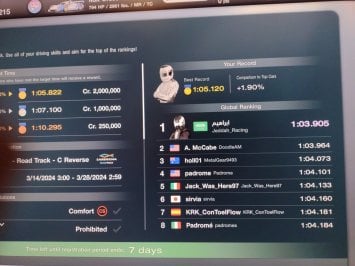
I go back and forth with CSA. I try not to use it but some cars just seem to need it for me. Haven't found the way it's fastest consistently at all for me with the Dino but weak is where my fastest time is. I'll try it stronger later. Most slidey cars seem to lose power on exit with it but that may just be my tail sliding style of driving too...
I feel like we are very similar in the way we drive and enjoy GT7, so I'm interested in what you think of CSA as it relates to actually sliding a car around.
In the real world when you're toying with oversteer the car will find opposite lock easily and it can be found/caught to maintain slip angle. The car naturally finds it on it's own through suspension geometry and you're free to do with it as you want, whereas in the game (this is independent of the snappy tire characteristic in GT) we have to actively hunt for opposite lock instead of cars falling into it. To me this makes for artificially difficult to control cars (especially with these snappy tires)... I'm used to it now, but don't think its terribly realistic.
Do you feel like adding in some CSA makes the car react more realistically to maintaining opposite lock (i.e the steering wheel moves towards lock better)? I've literally never used the assists in 7 and don't really ever think of them, so other than trying out TCS just to see how it functions and to have a basis for conversation, the other ones have never been toggled on. I have some time tomorrow to play around with it, but I'm interested to hear your take on it!
Every once in a while one of the crazy fast people let a hint slip. I have no idea what it actually means, as my method is 'just try to keep the bloody thing on the track', but I am sure this will help make somebody faster.

It's not so much a "hint" as much as it is feeling a car out and seeing what it reacts well to based on its drivetrain layout.
In the case of the Dino it is very prone to lift-throttle oversteer. So much so that when you're slowing down and turning into a corner it would rather continue rotating
around you than stay on the line you want it to. You steer it in very slightly in the direction of the corner, and often immediately turn
opposite the corner to correct the angle of the slide. Many mid-engine and rear engined cars have this trait because the bulk of their weight is towards the back of the car, and it acts like a pendulum trying to bring the rear of the car around you. This TT requires CS tires too, so grip levels aren't super high and that doesn't make learning this any easier!
These types of rear-weight cars also benefit from on-throttle traction. When you hit the gas, the weight is pushed down on the rear tires and you get more grip (and subsequently less in the front). When you're in a slide you can help correct it by giving it
more throttle, which feels like the opposite thing you should be doing. Most cars are front-engined rear-drive and don't want more throttle when you're in a slide (unless you're intentionally drifting), and these rear-weight biased cars just don't play in the same way. This concept of being mindful of the driven wheels and engine location applies to every car, and is a lot of the fun of being a car enthusiast.
It's also a trait that can be exploited and made useful. Once you learn the behavior you can play with how it reacts to different inputs. Pitch the car in to an angle you want, then control it as you maintain slip angle until it grips up in the rear.
This is a VERY difficult thing to do sometimes, so don't worry! This is challenging many of us! It took me a while to get into the 1:05s, and a LOT of those attempts ended with catastrophic wrecks. Keep playing with the car, have fun with it, and maybe you'll find the rhythm it dances to.





 🤣😂😅 as


 ).

 Hope for tomorrows new TT.