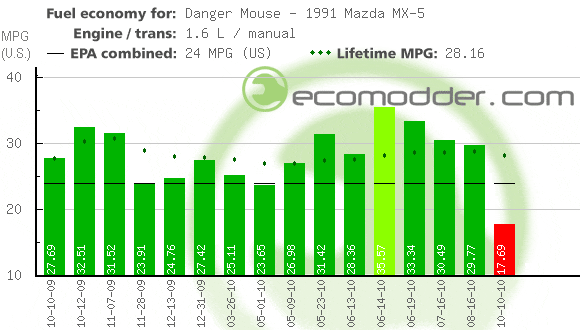
Go to a site like Ecomodder. Half the forum seem to quite comfortably beat EPA figures, many without even trying.
In fact:
That was my old Miata. Few low results there (the 17mpg one was anomalous - probably a poor calculation on my part), but a fair few at roughly 10mpg more than EPA. And plenty at more than 5mpg above EPA, in mixed driving. And I don't hypermile, I just drive economically most of the time and have fun when the opportunity presents itself. I'm pretty sure if I'd put my mind to it I could have consistently achieved 10mpg above EPA.
Not all cars can do that of course, but I suspect rather more than "none" can.
But your comparing tankfuls of seemingly un-monitored highway vs city mileage, to EPA combined estimates.
What I'm saying is driving 100% on highway (cross country) cruise on and cruise off, I've never seen 10mpg over highway estimate.
Entirely to many variables in city and combined to get truly accurate results IMO.
Did I ever say anything like that?
I mention EPA-tailoring because many cars are tailored to the EPA regimen. The first-generation Honda Fit isn't.
I've no way of knowing for sure, I know Honda's all have quick gearing (at least somewhat older and before) but this also applies to the 95 Civic, which is why I see it as equal.
Still, the point stands. Estimating a new EPA number on some arbitrary percentage calculation ignores the fact that mileage can't be calculated that way simply because the cruising speed changes. If a car is at optimum cruising speed at the old EPA cruising test and beyond that (and out of lean-burn mode and into the regular MAP-regulated mode) at the new cruising speed, then simply applying a percentage change will not realistically reflect that change.
But we don't know that's what the EPA did, they don't specifically (that I saw) say exactly how they re-calculated it.
But it's a fair point if they did, somewhat.
Somewhat, because a car designed for optimal efficiency at 55mph won't suddenly drag way down at 65mph (typically) there is a noticeable difference, just not huge.
All my fuel testing is done with GPS-corrected odometer readings and full-tank to full-tank testing. The only thing I'd be bragging about here is the insane amount of money I spend to test fuel economy on media test units when most other drivers are content to read the trip-meter and make a guesstimate off of that.
I wasn't specifically referring to you, if you dig through the site I linked you'll find people claiming 70+mpg on the highway with hybrids, and generally ridiculous claims.
Sure, it's not quite as accurate as the guys who drain gas tanks, run the car dry, fill up, then weigh the remaining fuel after a run... but... seriously, that's overboard.

I find the GPS not even necessary, long ago I questioned speedometer (and subsequently, odometer) readings, I then learned U.S. highway mile markers are very inconsistent, I've seen them jump 5 miles in 3 miles distance, the trick is, over a long trip, they add up.
The difference in my current speed/odometer reading and measured mileage by directions and highway signs over long trips is less than .5%, if there's any difference at all.
So now I just fill the tank, check fuel put in, and divide the mileage by gallons of fuel,
inaccurate for a single tank,
very accurate for dozens of tankfuls in a row combined.

So 55 mpg in urban driving isn't beating the Fit's numbers by dozens? City driving is difficult to gimmick because of the acceleration cycles and idling cycles. Cars spend less time in lean-burn and cruise on the city cycle than on the highway cycle. Mazda fought with the EPA because their "city" cycle doesn't show the full effect of their stop-start technology. If you can get decent city numbers, then the car will be fuel efficient.
Is that a U.S. spec car? And like I said, I've personally never seen anywhere near those gains, and frankly, I don't think for a second a U.S. spec Fit will see 55mpg highway, let alone city.
Now, if by urban you mean cruising at 35-40mph in 5th gear, yes. I believe that without a doubt, I've seen 4 cylinders with manuals get much higher than highway ratings in that range, it seems to be a sweet spot most people don't know about.
The gimmicking here is the shifting. The EPA allows ATs to shift whenever they want... so manufacturers can program shift points to take advantage of this. But the EPA gives set shift points for manuals. Some manufacturers can tune their engines based on this... hell... a lot of US-market engines we've tested make a lot of power up to 2500 rpm, drop-off between there and 4000 rpm in the lean-burn area... then make power again after. Gimmicky? Yes. Does it suck? Hell yes, I hate uneven power bands.
Well, most people driving manuals don't shift early enough by a long shot, so I see their point. My AT shifts into lock-up at 29mph, a very useful tool, if only I had it for second gear I'd be set.
But in the real world, it does make for better economy. Much more than a gimmicky EPA-friendly cruising gear that makes sixth/fifth too long for proper econo-cruising (which is best done at speeds below the EPA test speed).
But in the U.S. most highways have a limit of 65mph, which means (myself included) almost everyone goes at least 70mph, so it does benefit, just not as much as a quicker gear at a lower speed could.
Very difficult to prove... as the level of engine technology can vary very widely from manufacturer to manufacturer... the new diesels we have here tend to outperform their gasoline counterparts by 5-10 mpg (depending on conditions) while providing more useable torque over the entire rev range.
The big problem, again, is up-front price. The price of diesel is too market dependent to be a big talking point. In any event, even in markets with expensive diesel (like the US), the economy of diesel vehicles still gives them an advantage. But there's often a $2000 - $4000 premium for the engine versus a gasoline engine with the same power output. (Still better than the $4000 - $6000+ hybrid premium)*
It bears remembering that a 170 hp turbocharged diesel is going to give much better acceleration and economy than a 170 hp naturally aspirated gasoline engine. Hell... that porker of a Focus weighs nearly 1.5 tons, 500+ pounds more than my Protege... and while my car makes 175 hp, the Focus outdrags it with "just" 135.
And it still has economy similar to a much smaller gasoline engine.
These new direct injection turbocharged small-displacement gas engines might be able to match diesel economy and power, but they will obviously carry a price premium, too. I can't wait to test one, myself.
Best place to see the comparison? UK market publications. They often have very balanced reviews of gas and diesel cars... but given the high tax there, the price premium of diesel is amplified.
In the end, in economical terms, diesel might not be worth it... long-term maintenance and running costs partially negate the fuel savings, and the upfront price premium will always be a problem... like hybrids, diesels will most benefit those who do a lot of miles a year... but payback time is often much shorter, and... well... because turbo. Who doesn't love a rush of torque to the head?
Now if they could only make them sound nice.[/color][/b]
*Price premiums depend on the cars... on luxury cars, the premiums are hidden behind the huge markups, so they're mostly non-existent. On economy cars, the price difference is often a significant portion of the purchase price.
You and RJ don't want to hear my thoughts on Mazda powerbands, and under performance. So I'll leave it at "RX-7's were awesome", and I like the newer FWD, I think it's the 3, with a turbo and 260hp.
As for Diesel, I think if nothing else, the cost + interest will rob anyone of any potential savings. 7 year loans make 2K turn into 4K, let alone a 4K difference.
BTW - tidbit on ethanol, did not know, makes me happy I usually use 93 octane, which has either less or no ethanol.