Non-Linear Throttle possible fix?

  • Thread starter Thread starter Reddog88
  • 23 comments
  • 2,141 views
Messages
4
United States
United States
This is far from a new topic with GT7, I’ve searched quite a bit for more info and possible fix’s with no luck. If there is something I’ve missed please point me in the right way.
Since I’ve found nothing, and it drives me nuts having 2” travel in the pedal and only able to use maybe 3/4” for nearly the entire throttle band, I thought I would tackle making a custom response curve for my pedal set to offset the strikingly bad progressive curve in GT7. The results are very nice after just a couple hours of tweaking.
I recently upgraded to the Logitech RS Pedals and using the G-Hub software on my PC, I made a custom curve where all the inputs actually match (or darn close, just needs a little more fine tuning).
I’ve gotta say it takes a little getting used to after years of driving with standard in game curve, but if anybody is interested in the data points for it, let me know and I’ll find a way to post them once I get it dialed in just a little more. Of course you’ll need a pc and pedal software that allows custom response curves to try it out. .
 
This is far from a new topic with GT7, I’ve searched quite a bit for more info and possible fix’s with no luck. If there is something I’ve missed please point me in the right way.
Since I’ve found nothing, and it drives me nuts having 2” travel in the pedal and only able to use maybe 3/4” for nearly the entire throttle band, I thought I would tackle making a custom response curve for my pedal set to offset the strikingly bad progressive curve in GT7. The results are very nice after just a couple hours of tweaking.
I recently upgraded to the Logitech RS Pedals and using the G-Hub software on my PC, I made a custom curve where all the inputs actually match (or darn close, just needs a little more fine tuning).
I’ve gotta say it takes a little getting used to after years of driving with standard in game curve, but if anybody is interested in the data points for it, let me know and I’ll find a way to post them once I get it dialed in just a little more. Of course you’ll need a pc and pedal software that allows custom response curves to try it out. .
I’m very interested. I even had an ai agent try to make a curve for me. I have the Logitech pro pedals. Maybe @LOGI_Rich has some thoughts. He has said before the default should linear.
 
Last edited:
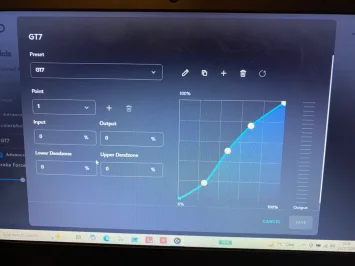
So I asked Grok to make a curve for me. This is what it came up with. Gonna test later tonight.
IMG_2642.webp
 
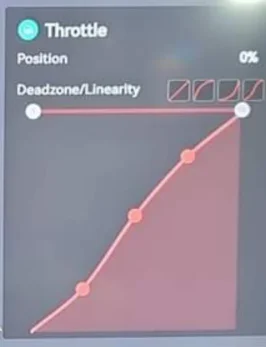
I’ve also been looking into the throttle curve for gt7 and found a post on fb where an engineer said race car and indeed road car throttle curves are never linear. He posted a curve that I replicated in Ghub and have so far had very good results with. His was the red curve and you see how I’ve replicated as best I could.
 

Attachments

  • C8D6988C-465E-411B-9402-8FDB73AD0A2B.webp
    C8D6988C-465E-411B-9402-8FDB73AD0A2B.webp
    79.6 KB · Views: 3
  • 3B73AD1E-82A1-4711-99A4-27A8499810EA.webp
    3B73AD1E-82A1-4711-99A4-27A8499810EA.webp
    16.5 KB · Views: 5
I’ve also been looking into the throttle curve for gt7 and found a post on fb where an engineer said race car and indeed road car throttle curves are never linear. He posted a curve that I replicated in Ghub and have so far had very good results with. His was the red curve and you see how I’ve replicated as best I could.
Did they say it’s one curve for race cars and another for road cars?
 
Now I can’t find the fb post to confirm😡 but sure he said both and I took it to also mean modest everyday cars.

Whenever I change my hardware I take a stock NSX 02 around Nords to compare times and I’ve taken 1.4 seconds off my previous best using that curve.

I see the theory in this curve as slightly less throttle initially to help prevent wheel spin but after the first point it ramps up giving more power than a straight line and it feels like riding a wave as it’s even improved my drifting. I’m having so much fun feathering supercar throttles on sports tyres.
 
Last edited:
There's more to it than just the pedal map, see this video by Niels Heusinkveld for example:
GT7 is firmly in the linear throttle category so no matter what you do to the pedal response, it'll never be right.
 
Weird af! Playing with my thrustmaster t598 for about 1 month now and everything worked fine till 2 day ago.. where my gas pedal started to feel off. Noticed pretty fast that when i press 50% only 25% is applied, at 75% its 50% but when i go 100% it is 100%.. so i went to the calibration but everything works fine there. The base recognize the right amount i press.. even when i go to the settings for wheel calibration in gt7, its right,25%=25%,50%=50%... but when i start playing in whichever mode or car the problem is there. I have no idea how thats even possible when its right in the options. i tried it on PC and in the f1 game on ps5 and its right.. the fact that in the gt7 options it is right but ingame on track not just breaks me
 
I'm also interested in fine-tuning the response of my RS throttle pedal, but first I need to understand how the game implements the throttle response when using wheel&pedals.

I've read this thread and looked for more info in other GTP threads but, honestly, I didn't find common ground position on whether GT7 built-in throttle response is either linear or progressive (some say GT Sport used to be progressive but GT7 is linear? - I can't tell the difference as I haven't played GT Sport). Others in the RS50 settings and tips thread claim GT7 built-in throttle response is more like a 'low' sensitivity curve instead of a linear one.

So, for guys who have been on a wheel & pedals setup for longer and possibly played other Gran Turismo installments, what is the most widely accepted position regarding throttle built-in response in GT?
 
I did a bunch of homework on this with ai and this was my conclusion:

GT7’s throttle IS linear (pedal % = torque request %), unlike GT Sport which had a progressive curve.
However, what feels “non-linear” is how each car responds to that torque request:
Why different cars feel different:
∙ Engine torque curves - Turbo engines feel “dead” until boost hits (~4000 RPM), then violent. NA engines feel progressive throughout the rev range.
∙ Gear ratios - 2nd gear feels touchy (high torque multiplication), 6th gear feels smooth (low multiplication). Same throttle %, completely different response.
∙ Tire load sensitivity - 60% throttle with light rear tires (mid-corner) = wheelspin. Same 60% with loaded rear tires (track-out) = clean acceleration.
∙ Weight transfer - Aggressive throttle shifts weight to rear → more rear grip but front lifts → can’t hold steering angle yet.
This is why you can’t “fix it” with static pedal curves - a curve that helps in one situation (6th gear, high-speed) hurts in another (2nd gear, hairpin exit). The “non-linearity” changes dynamically based on gear, RPM, corner angle, and tire load.
What top drivers do: Learn each car’s power delivery and adapt their throttle application per situation rather than using curves. Example: Turbo cars need progressive application (40%→60%→100%) to manage boost onset. NA cars can take more aggressive application.
TL;DR: GT7’s throttle input is linear, but car physics aren’t. Custom curves can’t account for changing grip/torque/load conditions.
 
I did a bunch of homework on this with ai and this was my conclusion:

GT7’s throttle IS linear (pedal % = torque request %), unlike GT Sport which had a progressive curve.
However, what feels “non-linear” is how each car responds to that torque request:
Why different cars feel different:
∙ Engine torque curves - Turbo engines feel “dead” until boost hits (~4000 RPM), then violent. NA engines feel progressive throughout the rev range.
∙ Gear ratios - 2nd gear feels touchy (high torque multiplication), 6th gear feels smooth (low multiplication). Same throttle %, completely different response.
∙ Tire load sensitivity - 60% throttle with light rear tires (mid-corner) = wheelspin. Same 60% with loaded rear tires (track-out) = clean acceleration.
∙ Weight transfer - Aggressive throttle shifts weight to rear → more rear grip but front lifts → can’t hold steering angle yet.
This is why you can’t “fix it” with static pedal curves - a curve that helps in one situation (6th gear, high-speed) hurts in another (2nd gear, hairpin exit). The “non-linearity” changes dynamically based on gear, RPM, corner angle, and tire load.
What top drivers do: Learn each car’s power delivery and adapt their throttle application per situation rather than using curves. Example: Turbo cars need progressive application (40%→60%→100%) to manage boost onset. NA cars can take more aggressive application.
TL;DR: GT7’s throttle input is linear, but car physics aren’t. Custom curves can’t account for changing grip/torque/load conditions.
Not all turbocharged engines have severe lag like that. My Tremor has an engine very similar to the one in the '18 Ford GT. It's the 3.5 EcoBoost, the turbos are small and work in parallel. There is no noticeable lag. A few other in game cars have had multiple turbos over the years for the same reason.
My power band is between 2,400 and 4,000 RPM.
 
Weird af! Playing with my thrustmaster t598 for about 1 month now and everything worked fine till 2 day ago.. where my gas pedal started to feel off. Noticed pretty fast that when i press 50% only 25% is applied, at 75% its 50% but when i go 100% it is 100%.. so i went to the calibration but everything works fine there. The base recognize the right amount i press.. even when i go to the settings for wheel calibration in gt7, its right,25%=25%,50%=50%... but when i start playing in whichever mode or car the problem is there. I have no idea how thats even possible when its right in the options. i tried it on PC and in the f1 game on ps5 and its right.. the fact that in the gt7 options it is right but ingame on track not just breaks me
This is EXACTLY what I came to check and write about. Same here. Im pretty sure this started recently. It was fine before. Now, with any car, only last 25% is usable. Its really hard to drive and adjust my memory with it. Weird.
 
So at the end, is it useless to change the response curve? if so, i'll avoid to waste time to tune it
Throttle Curves - Usually Not Worth It:
Why they don’t help much:
GT7’s throttle is linear (pedal % = torque request %), but each car responds differently based on:
∙ Engine type (turbo feels “peaky” vs NA feels linear)
∙ Gear ratios (2nd gear touchy, 6th gear smooth - same throttle input)
∙ Tire load (mid-corner = wheelspin risk, track-out = full grip available)
A static curve can’t adapt to these changing conditions. What helps in 6th gear will cause wheelspin in 2nd gear.

Exception: If you have a specific repeated problem (e.g., “I always overshoot 50% and spin exiting hairpins”), you could create a curve that compresses the 40-60% zone. But fixing your foot control is usually better than band-aiding it with a curve.

Start with linear (sensitivity 50). Drive for 10-20 hours.

If you notice a specific repeated issue:
∙ “I keep accidentally activating throttle when resting my foot” → Small deadzone
∙ “I can’t feel the difference between 85% and 95% brake” → Stretch that zone
If you’re just “trying to go faster”: Don’t waste time on curves. Focus on technique (brake timing, throttle commitment, racing line).
Bottom line: Not useless, but probably not where your time loss is. Most of the lap time is in technique (brake release timing, commitment, line), not pedal calibration.
 
Last edited:
Throttle Curves - Usually Not Worth It:
Why they don’t help much:
GT7’s throttle is linear (pedal % = torque request %), but each car responds differently based on:
∙ Engine type (turbo feels “peaky” vs NA feels linear)
∙ Gear ratios (2nd gear touchy, 6th gear smooth - same throttle input)
∙ Tire load (mid-corner = wheelspin risk, track-out = full grip available)
A static curve can’t adapt to these changing conditions. What helps in 6th gear will cause wheelspin in 2nd gear.

Exception: If you have a specific repeated problem (e.g., “I always overshoot 50% and spin exiting hairpins”), you could create a curve that compresses the 40-60% zone. But fixing your foot control is usually better than band-aiding it with a curve.

Start with linear (sensitivity 50). Drive for 10-20 hours.

If you notice a specific repeated issue:
∙ “I keep accidentally activating throttle when resting my foot” → Small deadzone
∙ “I can’t feel the difference between 85% and 95% brake” → Stretch that zone
If you’re just “trying to go faster”: Don’t waste time on curves. Focus on technique (brake timing, throttle commitment, racing line).
Bottom line: Not useless, but probably not where your time loss is. Most of the lap time is in technique (brake release timing, commitment, line), not pedal calibration.
got it, thank you.but anyway does this settings carry over on gt7 or is it just for PC?
 
Throttle Curves - Usually Not Worth It:
Why they don’t help much:
GT7’s throttle is linear (pedal % = torque request %), but each car responds differently based on:
GT7's throttle is only linear on GT7's settings calibration page. Once you start driving in a race or time trial or mission, it changes 50% throttle to almost nothing and 75% throttle to 50%, making holding a drift near impossible. The response curve you posted above to make 50% pedal into 75% throttle and 75% pedal into 90% throttle absolutely fixes this. I didn't know Ghub would only let you save a response curve to the pedals only if the pedals are plugged directly into a PC, it doesn't give you that option if the pedals are plugged into the wheelbase and then the wheelbase plugged into the PC. Now I need to see if I can make simhub also display GT7's handbrake output, in case GT7 is also making my RS analog handbrake non-linear.
 
So, guys, this throttle situation in GT7 is normal?! How?

(Sorry for my English) but...

This means that if you want to be fast and competitive in GT7, and ease off some throttle to slow down, you have to physically release the gas pedal only a few millimeters or idk... 1 cm with your foot when braking and when cornering, not half, or more, as you would in a real car? It is completely incomprehensible to me. If I have a pedal range of 0 - 100%. Why would you use only the last 15% or, physically, 1 or 1.5 cm of, say, 5-8 cm of pedal range in a turn? I expect when entering corners to learn my pedal range, and if I need 50% of throttle in a corner, I'd release 50% of the pedal range with my foot, not just a very small amount... This is too strange for me. I'm not with Poliphony on this decision...
 
Last edited:
GT7's throttle is only linear on GT7's settings calibration page. Once you start driving in a race or time trial or mission, it changes 50% throttle to almost nothing and 75% throttle to 50%, making holding a drift near impossible. The response curve you posted above to make 50% pedal into 75% throttle and 75% pedal into 90% throttle absolutely fixes this. I didn't know Ghub would only let you save a response curve to the pedals only if the pedals are plugged directly into a PC, it doesn't give you that option if the pedals are plugged into the wheelbase and then the wheelbase plugged into the PC. Now I need to see if I can make simhub also display GT7's handbrake output, in case GT7 is also making my RS analog handbrake non-linear.
What is exactly the responde curve you have tried? I would like to try it too thank you.
At the moment i'm using this (created by a user named Flux89) and at the moment it seems nice.

Input → Output
1. 0% → 0%
2. 5% → 8%
3. 10% → 16%
4. 20% → 35%
5. 30% → 48%
6. 40% → 60%
7. 50% → 70%
8. 60% → 78%
9. 70% → 86%
10. 85% → 94%
11. 100% → 100%
 
What is exactly the responde curve you have tried? I would like to try it too thank you.
At the moment i'm using this (created by a user named Flux89) and at the moment it seems nice.

Input → Output
1. 0% → 0%
2. 5% → 8%
3. 10% → 16%
4. 20% → 35%
5. 30% → 48%
6. 40% → 60%
7. 50% → 70%
8. 60% → 78%
9. 70% → 86%
10. 85% → 94%
11. 100% → 100%
Flux89’s curve is very aggressive - it boosts your input by +15-20% across the entire mid-range.
Here’s what it’s actually doing:
Flux89’s curve:
∙ 50% pedal → 70% output (+20% boost)
∙ 75% pedal → 87% output (+12% boost)
For comparison, a milder alternative would be:
∙ 50% pedal → 58% output (+8% boost)
∙ 75% pedal → 82% output (+7% boost)

Why Flux89’s curve feels like it “fixes” GT7:
It’s compensating for the perception that “50% throttle = almost nothing.” But this only happens in specific conditions:
∙ Turbo cars below boost threshold (~3500 RPM)
∙ Low gears (2nd-3rd) where torque is weak
∙ Mid-corner where you can’t use full throttle yet
In those situations, boosting 50% → 70% makes the car feel more responsive because the engine was weak there anyway.

The trade-offs:
✅ What this curve helps with:
∙ Turbo cars feel less “peaky” (smoother mid-range response)
∙ Easier to maintain drifts (more throttle authority at 40-60%)
∙ Less “dead zone” feeling in 2nd-3rd gear exits
❌ Potential problems:
∙ Wheelspin risk increases - You think you’re at 50% but the game sees 70%. In high-torque situations (2nd gear, full boost), this can break traction when you don’t expect it.
∙ Harder to modulate in high-grip situations - 6th gear on a straight with full downforce? You’re now underusing available grip because you’re not pushing the pedal far enough.
∙ Doesn’t adapt to different cars - Works great for turbo cars (WRX, GT-R, Supra), but NA cars (Ferrari 458, Corvette) are already linear and don’t need this boost.
Most importantly: You’re now relearning where “50%” is. Your foot is adapting to the curve, not the car. If you switch to a different car or go back to linear, it’ll feel completely wrong.

My suggestion:
If you want to try a curve, start more conservatively:

Input → Output
0% → 0%
25% → 24%
50% → 58%
75% → 82%
100% → 100%


This gives you +8% boost in the mid-range (helps with “dead zone” feeling) without the extreme +20% that can cause unexpected wheelspin or require complete recalibration of your muscle memory.
Test it for 10-20 laps, then decide if you need more or less.

Bottom line:
Flux89’s curve isn’t “wrong” - if it feels good to you, use it. Just understand you’re optimizing for turbo cars in low gears, and it might work against you in other scenarios (NA cars, high gears, high-downforce corners).
The curve is compensating for how certain cars feel, not “fixing” something broken in GT7. GT7’s throttle is linear - what’s non-linear is how different engines/gears/tire loads respond to that linear input.
 
Last edited:
So, guys, this throttle situation in GT7 is normal?! How?

(Sorry for my English) but...

This means that if you want to be fast and competitive in GT7, and ease off some throttle to slow down, you have to physically release the gas pedal only a few millimeters or idk... 1 cm with your foot when braking and when cornering, not half, or more, as you would in a real car? It is completely incomprehensible to me. If I have a pedal range of 0 - 100%. Why would you use only the last 15% or, physically, 1 or 1.5 cm of, say, 5-8 cm of pedal range in a turn? I expect when entering corners to learn my pedal range, and if I need 50% of throttle in a corner, I'd release 50% of the pedal range with my foot, not just a very small amount... This is too strange for me. I'm not with Poliphony on this decision...
Your question: “Why would I use only 1cm of 8cm range?”
You wouldn’t. That’s not what’s happening.
What’s actually happening:
Corner entry (braking zone):
∙ Throttle: 0% (pedal fully released - using full range)
Mid-corner (trail throttle):
∙ Throttle: 20-40% (pedal 2-3cm down - using mid range)
Corner exit (accelerating):
∙ Throttle: 60% → 80% → 100% (pedal 5cm → 6cm → 8cm - using full range)
You’re using the ENTIRE 0-100% range physically.
The confusion is: People feel like “50% doesn’t do enough” in certain conditions (turbo lag, low gears), so they think GT7 is “wasting” the range. But it’s not GT7 - it’s the car’s engine/gear/tire physics.

Polyphony’s decision is actually correct:
Linear throttle means:
∙ 50% pedal = 50% torque request
∙ What the engine does with that 50% torque request depends on RPM, gear, boost, etc.
∙ This is how real cars work
If GT7 “corrected” this to make 50% always feel the same:
∙ It would be unrealistic (real turbo cars have lag)
∙ It would be inconsistent (different cars have different power curves)
∙ It would remove the skill of throttle modulation
The “problem” people are experiencing is learning to modulate throttle based on engine response - which is a driving skill, not a game flaw.

GT7 uses your full pedal range (0-100% physically).
What changes is how much acceleration you get from each percentage:
∙ 50% throttle at 3000 RPM (no boost) = slow acceleration
∙ 50% throttle at 5000 RPM (full boost) = fast acceleration
Curves like Flux89’s boost your input (50% → 70%) to compensate for turbo lag and make throttle feel more consistent across RPM ranges.
This makes driving easier but less realistic. It’s a valid choice if you prefer it, but it’s not “fixing” a problem with GT7 - GT7’s linear throttle is actually the realistic behavior.
You’re not using “only 1cm” of your pedal. You’re using the full range. The car’s response to that range just varies based on conditions.
 
Last edited:
GT7's throttle is only linear on GT7's settings calibration page. Once you start driving in a race or time trial or mission, it changes 50% throttle to almost nothing and 75% throttle to 50%, making holding a drift near impossible. The response curve you posted above to make 50% pedal into 75% throttle and 75% pedal into 90% throttle absolutely fixes this. I didn't know Ghub would only let you save a response curve to the pedals only if the pedals are plugged directly into a PC, it doesn't give you that option if the pedals are plugged into the wheelbase and then the wheelbase plugged into the PC. Now I need to see if I can make simhub also display GT7's handbrake output, in case GT7 is also making my RS analog handbrake non-linear.
I respectfully disagree - GT7’s throttle remains linear during races, not just in calibration.
What you’re experiencing as “50% = almost nothing” is the car’s dynamic response, not GT7 changing your input:
Test this yourself:
∙ Find a straight
∙ Hold exactly 50% throttle (watch GT7’s throttle HUD indicator)
∙ Shift through gears 2→3→4→5→6 without moving your foot
∙ Notice acceleration changes dramatically despite constant pedal position
Why this happens:
Turbo engines: 50% throttle at 3500 RPM (below boost) feels weak. Same 50% at 4500 RPM (in boost) feels violent. Your pedal didn’t change - the engine’s power delivery did.
Gear ratios: 50% in 2nd gear (high torque multiplication) feels aggressive. Same 50% in 6th gear (low multiplication) feels weak.
Tire load: 50% mid-corner (light rear tires) = wheelspin risk. Same 50% track-out (loaded tires) = clean power.
Your curve “fixes” this by boosting 50%→75% output, which compensates for turbo lag in low gears. That’s fine if it works for you, but understand:
✅ Helps: Turbo cars feel smoother, easier drift modulation❌ Drawbacks: Can cause wheelspin when boost hits, doesn’t adapt to different cars/gears, requires relearning foot control
This isn’t GT7 being broken - real turbo cars behave exactly this way (weak below boost, strong above boost). GT7’s linear throttle is actually the realistic behavior.
Re: handbrake - also linear. Any perceived non-linearity is physics (weight transfer, speed, surface grip) not GT7 applying curves.
 

Latest Posts

Back