Space In General

  • Thread starter Thread starter BubbleBelly542
  • 4,727 comments
  • 376,276 views
The MIRI unit of the JWST (aka the part that sees all the infrared wavelengths) is now at its proper operating temperature of -267 degrees Celsius, just six degrees over absolute zero. So if anyone dares you to stick your tongue on it... maybe don't do that.

_124134448_0806_filter_wheel.jpg


Once all calibrations and alignments are finished, MIRI will be seeing things in the near and mid infrared spectrum, in contrast to Hubble which sees light in the near ultraviolet, visible and near infrared ranges.

_122231233_jwst_spectrum_2x640-nc.png
 
I can't be the only one who thinks that's beautiful.
Lovely engineering, simple but effective! A central direct motor drives the filter wheel which falls into discrete positions by a ratchet mechanism. You can also see the coronagraph masks in filter 11,12,14,16, and 18 to block a star for exoplanet hunting and the like. Here are some more infos about the filters, from the JWST user docs. So excited that this stuff will be put to use real soon! 🥳
 
I've seen unconfirmed reports that several planets of the solar system are simultaneously undergoing significant changes in temperature. Anyone else heard about that?
 
I've seen unconfirmed reports that several planets of the solar system are simultaneously undergoing significant changes in temperature. Anyone else heard about that?
I've seen articles as such about Neptune but not any other planets.
 
Starlink launch successful this afternoon on Booster 1060 for its 12th flight.

 
I can't post the photo because it has since been removed, but Super Heavy Booster 7 has irreparable damage to some internal pieces and will likely be scrapped.
 

Light speed is hugest but space is huger... 🤯
 
Ax-1 crew splashed down today safely.


Also...


Edit:

 
Last edited:
4 came down yesterday, another 4 going up tomorrow.


Edit:

 
Last edited:
I've come to the realisation that landings are overtaking takeoffs in becoming the more spectacular aspect of space travel.
 
If its not apparent already by my posts, Twitter is a great source for all things space.

 
Last edited:
Starlink launch today with the shortest turnaround time for a booster at just 21 days.

 
Link for above mentioned launch.


Edit: mission successful, bullseye landing 🎯

 
Last edited:

But can they provide universal healthcare in a reasonable amount of time?

Anyways, when are they gonna launch this stonker? Is the booster going to land itself? Are they going to launch, hover, and land the entire rocket assembly?
 
Anyways, when are they gonna launch this stonker? Is the booster going to land itself? Are they going to launch, hover, and land the entire rocket assembly?
Still waiting on FAA environmental assessment. They keep delaying it 30 days which is annoying. The first launch is fully expendable. In the future the booster will be caught by the tower, Starship might be as well but I don't believe they have made a decision on that. Mars versions will have to land on their own obviously.
 
Rocket Lab will make their first attempt at catching a first stage booster in the air with a helicopter today. I'll update this post with the live stream when available.


Edit: Here we go

 
Last edited:
Update: they successfully caught the booster, but released it.

 
Busy 24 hours for SpaceX. Crew 3 separation from the ISS, splash down, Starlink launch, and now Booster 7 is back out at the launch site at Starbase after having some heart surgery. (Large tube inside collapsed during the last cryo test)


Starship 24 was fully stacked today. If all goes well this should be the one used for the first orbital flight.

 
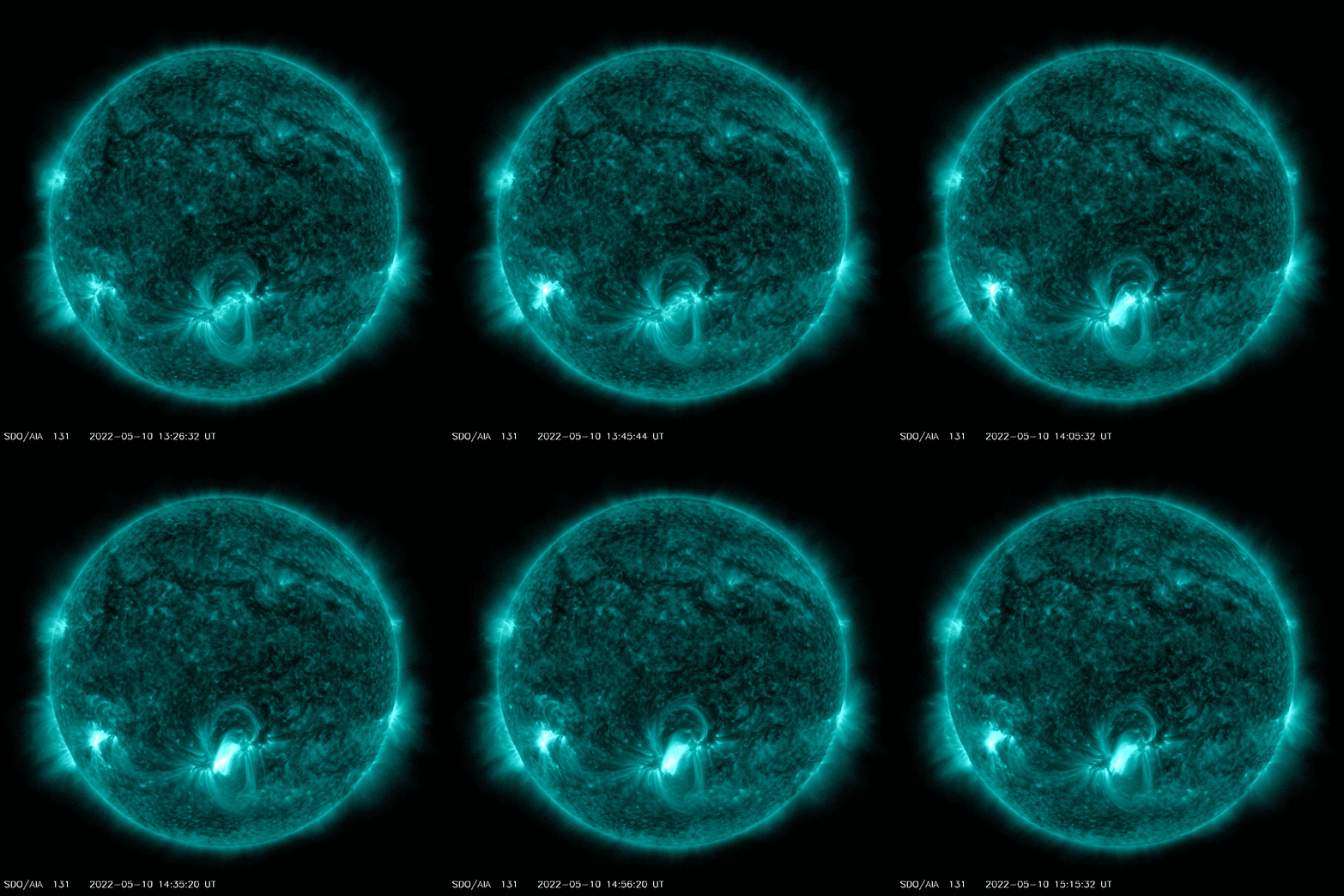
From today's edition of Spaceweather.com:

X-CLASS SOLAR FLARE: "Mixed-up" sunspot AR3006 (described below) exploded on May 10th (1355 UT), producing an intense X1.5-class solar flare. NASA's Solar Dynamics Observatory recorded the extreme ultraviolet flash:

​

Radiation from the flare ionized the top of Earth's atmosphere, causing a shortwave radio blackout around the Atlantic Ocean: blackout map. Radio transmissions at frequencies below ~30 MHz were attenuated for more than an hour after the flare.

Since the flare occurred, a mish-mash of CMEs has billowed away from the sun's southern hemisphere. It is unclear if these CMEs are related to the X-flare or instead some other, lesser explosions that happened at almost the same time. There was a filament eruption to the right of the X-flare, and a C4-class solar flare in a different sunspot to the left. NOAA analysts are busy unraveling these events using computer models to determine if one of the CMEs might hit Earth. Stay tuned. Solar flare alerts: SMS Text


Edit: Starship 20 is on its way back to the production site.

 
Last edited:
First picture of the Sagittarius A* black hole in the center of the Milky Way galaxy! Created using the Event Horizon Telescope.
1652361253431.png
 
Last edited:
Back