Weird automotive engineering solutions

  • Thread starter Thread starter Leonidae
  • 349 comments
  • 33,942 views
But if the piston is designed to retract a little, then those clips as eriksmil pointed out would push them off the rotor. Every set of brakes i've installed( obviously not near as many as you) have had the clips that connect the pads to each other and have enough spring to push them back against the piston.

Edit: I misread Famine's quote and thought it was saying the piston does move back a little. What are the dust boots and which seals flex?
The dust boot/seal is on the piston itself, so it could possibly pull the piston back marginally because of the fact that it's rubber. Again though, assuming you've got no air in your braking system, this would only be possible if the rubber seal could force the brake fluid in the caliper back up the lines.

I've seen very few spring clip things though.

I'm just having a hard time believing that the piston would be pulled back by the little tiny seals, which in turn would give that tiny amount of room for the pad to move, which would then be pushed back along the dirty piece of the caliper mounting bracket that it sits on, enough to just slightly sit off the rotor face at a clearance so tight that the smallest measurement on a feeler gauge couldn't even get completely through the gap, but it's still not actually touching.

Then all this is able to be repeated each and every time the brakes are released, despite the fact that a brand new set of brakes still has tolerances large enough to be able to fairly easily wiggle the brake pad around. Add brake dust and you haven't really got a precise, consistent system. At least not consistent to thousandths of an inch every single time.
 
Last edited:
I've seen very few spring clip things though.

That's weird, as when I had to drive without one on one side, you really heard it grind, whereas you didn't on the other side. Not just when you turned the wheel when the car was jacked up, but you could hear it when I drove away. Scratch-scratch-scratch..

I'm no physics guy or anything, but there's no surge or anything made by the air-tight brakes? And/or that it creates some pull on the piston when you release the heavy pressure?
 
Apart from anything else, logic dictates that a pad in constant contact with the disk would wear out both the disc and especially the pad prematurely, and the heat transfer would do the fluid and the brakes in general no good at all. The friction would also be detrimental, if only minutely, to the car's performance/fuel ecconomy. So surely braking systems are designed in some way to always have the pad slightly resting of the surface of the disk.
 
Change your rings.

Thanks. I'll try and take my engine completely apart and put it back together in one day, considering I kind of need the car.... *rolls eyes*

Yeah. You've got me really wishing I had a second engine to toy around with, now...
 
Thanks. I'll try and take my engine completely apart and put it back together in one day, considering I kind of need the car.... *rolls eyes*

Yeah. You've got me really wishing I had a second engine to toy around with, now...

It's simple... you just unscrew everything... stick those thingamajiggies in... ...fifteen minutes, tops... :lol: ...sorry, but that's the only solution. I've got a fouling problem, too... but I'm still trying to figure out if my valve seals are bad or if it's contamination from the propane system... if it's the former, the head has to come off again, which I don't want to do... if it's the latter, then... crap... I'm enjoying the fact that I pay half-the-price of gasoline for propane, and I don't want to have to avoid it on the off-chance that the filling stations have tanks full of oily contaminants... :ouch:

-

Don't we all? But I fear if I had an engine stand in the garage at home, my wife would utterly kill me. She sees little enough of me, as it is.
 
I suppose you could count the interior heating system used by VW back in the air-cooled days (not sure if there are other companies that used this).

If you don't know how it works, basically there's a fan shroud that sits on the engine block, and has a fan inside that runs off the crankshaft belt. It pulls up hot air from the engine and blows it through piping to a pair of heat exchangers on the exhaust manifolds (where the majority of the heat comes from), which then routes to inside the cabin in hoses within the rockers (under the doors). The fan is of course also used to help cool the engine.
 
The brakes on this Volvo Jakob concept.
Volvo_Jakob_hotrod_rear2_big.jpg
 
That Lincoln hatchback concept thing that was going around the show circuit this year had brakes like that. It's an interesting idea, but I'm not convinced it really gets much accomplished aside from looking cool.
 
I suppose that type of system improves brake cooling alot as the disc spins faster in the outer rim, and also increases disc surface are possibly. Also you dpon't need to apply as much pressure on the pads on the discs as they are on the outer edge of the rim.
 
Not entirely weird. But it is a bit odd. Almost like hydraulic rim brakes that they used to put onto bikes.

They still do. Well, Buell do:

146_0711_16_z+buell_1125r+ztl_brake.jpg


Meant to give more stopping power. Most journos report no difference. Looks cool though.
 
Well, I was talking more the ridiculous hydraulic rim brakes they put on trials bikes. Now those actually do give more stopping power over discs. They're also lighter than a disc so it gives a weight advantage.
 
Stopping power won't be affected by the size of the disc. The traction limit on your tires is the same whether you have a 5-inch brake disc or a 13-inch one. What is affected is brake fade and heat dispersion. In this, an inside-out disc brake is superior, as it has more surface area. Mounting is a female dog, though, and I don't suppose a racing team pitcrew could unmount and remount those things as quickly as a regular brake system, so they're not very common.
 
Actually....It may somewhat be affected.

Increasing the size of the rotor (assuming that the pad's friction force is the same, and the distance from the center of the brake IS changed) will, theoretically increase the braking torque by increasing the Lever Arm that the friction force works off of.

It's like...If you try to spin a wheel by the spokes vs the edge of the tire. It's harder to spin by the spokes because the edge of the tire is further from the Center. Now, driving said wheel is different, because what you're applying to the center is a pure torque, not a straightline force being converted to a torque.

Now, I don't know how much it'll matter in a pure racing application, because (a) all things equal, it increases rotational inertia of the assembly, and (b) the brakes are so effective on those cars anyway that it likely wont' matter much.
 
There is that, but beyond a certain point... the point at which the contact patch will not allow any further braking and the ABS kicks in... bigger brakes with more leverage are useless. If you can lock your brakes with the ABS off with your current set-up, you don't need much more for emergency use. But bigger and ever bigger brakes are still en vogue amongst performance makers due to the heat dissipation I mentioned above.

What might make that leverage more important, ironically, is the insistence of JDPowers of listing "brake dust" as a problem in their questionnaire... which is causing some automakers to go for brake pad compounds that produce less dust, and, obviously, less braking force.

The idiots. Porsche had the perfect answer to this conundrum... basically saying: "🤬 JDPowers... we build our cars for track use, we'll give them brakes they can take on track."
 
Increasing the size of the rotor (assuming that the pad's friction force is the same, and the distance from the center of the brake IS changed) will, theoretically increase the braking torque by increasing the Lever Arm that the friction force works off of.

But the braking force from the tire basically is nothing more than a torque in the opposite direction of the actual brakes. So that torque will not change unless you alter the size of the wheel.

Because the maximum braking torque is constant, moving the disc farther out does reduce the necessary force the actual brakes have to provide. So in that case, your brakes have to be less sturdy to get the job done.
 
Ah, that does make sense.

See, this is why Engineers work in teams. Someone's bound to miss something.
 
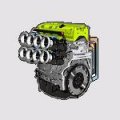
Has anyone heard about Coates? I heard that last year they started building a land speed record car, using their CSRV-engine..
 
I just found this "rotary valve" thing...and am intrigued. They simply need to figure out how to get this to manufacturers at (IMPORTANTIMPORTANT) the right price...which may mean selling the patent.
 
all they would need to do is a little more research on hydrodynamics and it could be done. however, 400 knots under water.. the steering would be interesting. :D
 
In 1992 the HONDA NR750 '92 was a revolution in new tecnology:

The famous oval piston and 8 valves per cylinder!

meer750.png


Engine - Liquid cooled, four stroke, 90°V-four oval cylinder, DOHC, 32 Valve

Others: Honda's advanced forward thinking design features for the time included, front indicators integrated into mirrors, twin exposed side mounted radiators, underseat exhaust and a louvred swooping fairing constructed from carbon fiber with a one piece tail unit. The rider was protectd from the wind by a titanium tinted windscreen.

53483286.jpg
 
In 1992 the HONDA NR750 '92 was a revolution in new tecnology:

The famous oval piston and 8 valves per cylinder!

meer750.png


Engine - Liquid cooled, four stroke, 90°V-four oval cylinder, DOHC, 32 Valve

That's cool, why isn't that in cars yet?
 
Well, it wasn't so much an ADVANTAGE as it was TAKING ADVANTAGE OF RULES. V8s weren't allowed in Motorcycle racing at the time, so, instead, Honda cut the space between a couple cylinders out, and made a four cylinder out of a V8....thus being within the rules.

With 32 valves instead of 16, the bike could flow that much better, and made a ton of horsepower: unfortunately, there were some problems, and before the engine was completely hammered out, I believe it was outlawed.
 
Coates is still around?

They've been peddling their rotary valve concept for a long time. In fact, if I didn't know that rotary valves were actually possible, I'd have called them vaporware a long time ago.

Lots of engineering challenges there... no way to implement variable "lift" (in this case, variable depth would be more appropriate) and a limited amount of variable timing allowed...
 
Back