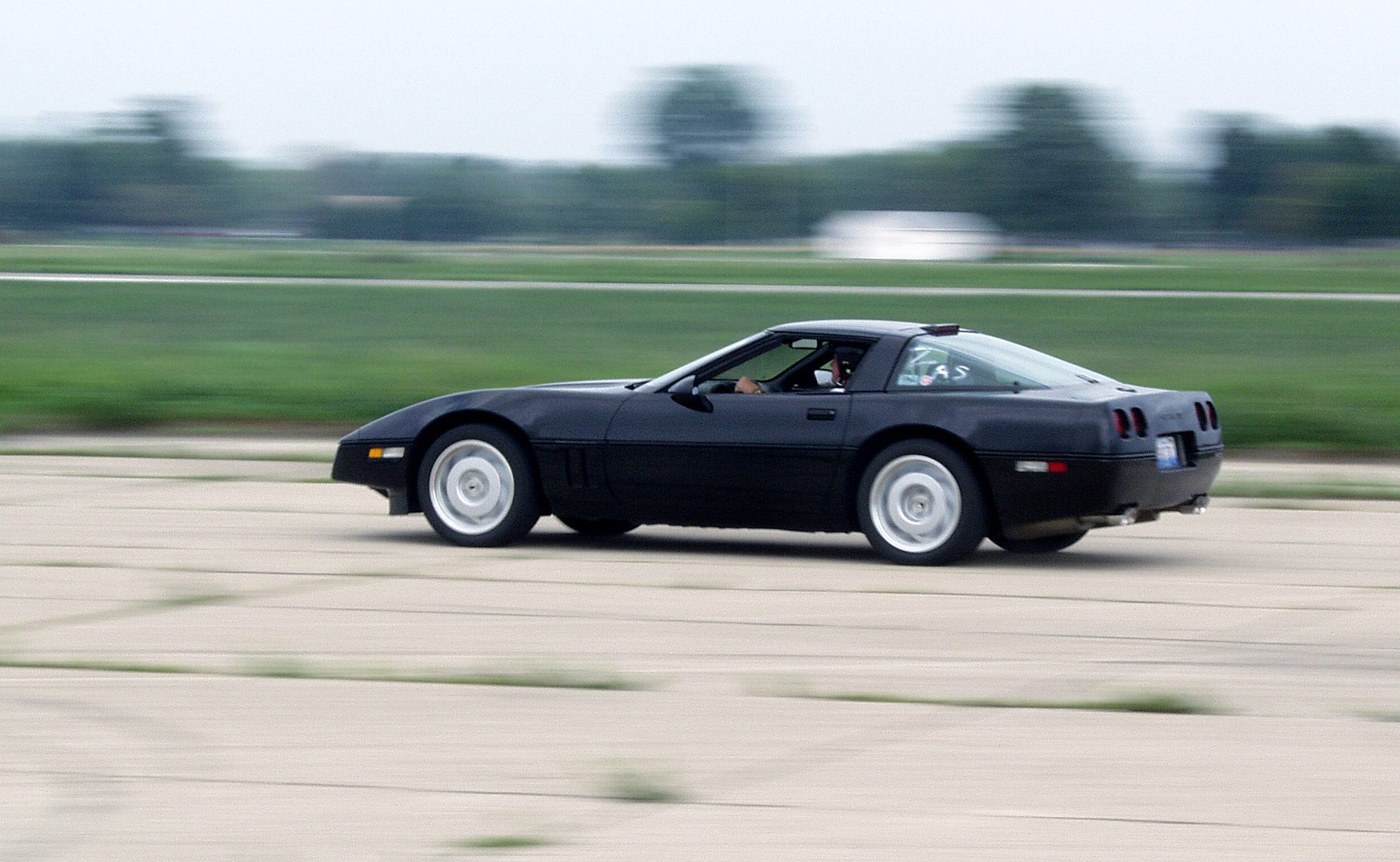
What exact kind of corvette is this?

  • Thread starter Thread starter Dagger311
  • 29 comments
  • 6,646 views
Messages
6,658
United States
Marietta, GA
Messages
Dagger31198
tmp_IMG_20140131_150931582498356.jpg

Wikipedia pictures place it as either a c4 Coupe, or a c4 Zr1, and I was hoping it's the latter.
 
I think it's a ZR1...not entirely sure though.
 
Not so sure it is.

While it is easier to tell from the front or back, one way to spot a ZR1 is a center brake light mounted on the roof above the rear window.

Not sure I see it in that picture above.
 
Not so sure it is.

While it is easier to tell from the front or back, one way to spot a ZR1 is a center brake light mounted on the roof above the rear window.

Not sure I see it in that picture above.
There's none above the rear window, but it looks like there's a bump up top.
 
Here is a rear picture, no center brake light.

tmp_IMG_20140131_150933967692098.jpg
 
While it is easier to tell from the front or back, one way to spot a ZR1 is a center brake light mounted on the roof above the rear window.
I think that disappeared with the facelift, not 100% sure though.
 
I think that disappeared with the facelift, not 100% sure though.
Could have, never even thought of that.

Second, what's a facelift?
 
There's none above the rear window, but it looks like there's a bump up top.

I see something, but it may be just the pixels of the photo. The brake light is actually quite large.

ZR1:
vemp_1002_02_o%2Bc4_corvette_zr_1%2Brear.jpg


Base C4:
c4-corvette-feature-article-dressed-nines-rear.jpg
 
I see something, but it may be just the pixels of the photo. The brake light is actually quite large.

ZR1:
vemp_1002_02_o%2Bc4_corvette_zr_1%2Brear.jpg


Base C4:
c4-corvette-feature-article-dressed-nines-rear.jpg
Can you get a picture like that from the sides as well? Would help, since that's how my first picture is taken.
 
Could have, never even thought of that.

Second, what's a facelift?
The C4 recieved a facelift in '91.
You can tell from the front lights. IIRC the vanilla C4 had those "turbine" wheels after 1991.
 
Can you get a picture like that from the sides as well? Would help, since that's how my first picture is taken.

Here's a couple side views of a ZR1:

Corvette_ZR1.jpg


90ZR1B-02.JPG


A base C4 for comparison:
1996_Chevrolet_Corvette_Coupe.jpg
 
Here's a couple side views of a ZR1:

Corvette_ZR1.jpg


90ZR1B-02.JPG


A base C4 for comparison:
1996_Chevrolet_Corvette_Coupe.jpg
As much as I hate to admit it, I think I can say it's not a ZR1. The brake lights on the pictures you gave are just too evident, compared to the lumps on mine.
 
Yeah it's probably just a '91-'96 base C4.

Pre facelift headlights '84-'91:
Chevrolet-Corvette_C4_mp15_pic_493.jpg


Facelift headlights '91-'96:
352441-1000-0.jpg
 
Yeah, I'm almost positive it's just a base now. Still pretty nice though.
 
As much as I hate to admit it, I think I can say it's not a ZR1. The brake lights on the pictures you gave are just too evident, compared to the lumps on mine.

It doesn't appear the car in your first pic is a ZR1. I've been trying to look closer at the rear view picture that you posted but the car is too small for my eyes. A ZR1 will have 2 black bars between the license plate and the reverse lights because of the wider body.(See the white ZR1 and blue C4 above)

Glad I could help though. 👍
 
It doesn't appear the car in your first pic is a ZR1. I've been trying to look closer at the rear view picture that you posted but the car is too small for my eyes. A ZR1 will have 2 black bars between the license plate and the reverse lights because of the wider body.(See the white ZR1 and blue C4 above)

Glad I could help though. 👍
I can guarantee there's no light on the back. In the gallery on my device, the picture is a whole lot clearer. Thanks for all the help, to everyone.
 
I would say it's a 91 -96 C4.
The vents on the side are a dead give away.

Which package?
With no side or rear badging I'd say it's just an LT1 C4.
No Gran Sport strips either.
 
I would say it's a 91 -96 C4.
The vents on the side are a dead give away.

Which package?
With no side or rear badging I'd say it's just an LT1 C4.
No Gran Sport strips either.
LT1, that's just the base c4, right?
 
I agree with the others, I'm pretty sure it's just a normal facelifted C4 Corvette. Still nice to me, but that's because I love the facelifted C4 Corvettes. :D

Another way I'm able to tell that it's a base model are the wheels, the wheels on a corvette ZR-1 have 5 spokes usually while a base C4 corvette has those saw blade styled wheels.
 
I agree with the others, I'm pretty sure it's just a normal facelifted C4 Corvette. Still nice to me, but that's because I love the facelifted C4 Corvettes. :D

Another way I'm able to tell that it's a base model are the wheels, the wheels on a corvette ZR-1 have 5 spokes usually while a base C4 corvette has those saw blade styled wheels.
Didn't know that, although I did think the wheels were pretty nice when I saw them.
 
The LT1 is the base engine with 300 hp.
In 92 it replaced the older L98 which had about 250 hp.
Both are 5.7 liter/ 350 cubic inch engines.
96 saw the new LT4 (5.7) engine with 330 hp.
The LT5 (still 5.7) was the ZR1 engine which had between 375 and 405 hp.
 
CHMSL became standard on all cars after 1986. It has nothing to do with it being a ZR-1, more likely a base model C4 Vette. Most cars have the CHMSL in the rear window or on the trunk/boot lid these days.

From wiki links:


In the United States and Canada since 1986, in Australia and New Zealand since 1990, and in Eurasia since 1998, a central brake lamp, mounted higher than the vehicle's left and right brake lamps and called a "centre high mount stop lamp (CHMSL)", is also required. The CHMSL (pronounced /ˈtʃɪmzəl/) is also sometimes referred to as the "centre brake lamp", the "third brake light", the "eye-level brake lamp", the "safety brake lamp", or the "high-level brake lamp". The CHMSL may produce light by a single central filament bulb, a row or cluster of filament bulbs or LEDs, or a strip of Neon tube.

The CHMSL is intended to provide a deceleration warning to following drivers whose view of the vehicle's left and right stop lamps is blocked by interceding vehicles. It also helps to disambiguate brake vs. turn signal messages in Northern America, where red rear turn signals identical in appearance to stop lamps are permitted, and also can provide a redundant stop light signal in the event of a stop lamp malfunction.

The CHMSL is generally required to illuminate steadily and not permitted to flash,[75][76] though U.S. regulators granted Mercedes-Benz a temporary, limited exemption to the steady-light requirement so as to evaluate whether a flashing CHMSL provides an emergency stop signal that effectively reduces the likelihood of a crash.[77]

On passenger cars, the CHMSL may be placed above the back glass, affixed to the vehicle's interior just inside the back glass, or it may be integrated into the vehicle's deck lid or into a spoiler. Other specialised fitments are sometimes seen; the Jeep Wrangler and Land Rover Freelander have the CHMSL on a stalk fixed to the spare wheel carrier. Trucks, vans and commercial vehicles sometimes have the CHMSL mounted to the trailing edge of the vehicle's roof. The CHMSL is required by regulations worldwide to be centred laterally on the vehicle, though UN Regulation 48 permits lateral offset of up to 15 cm if the vehicle's lateral centre is not coincident with a fixed body panel, but instead separates movable components such as doors.[17] The Renault Mastervan, for example, uses a laterally offset CHMSL for this reason. The height of the CHMSL is also regulated, in absolute terms and with respect to the mounting height of the vehicle's conventional left and right stop lamps.[78] Depending on the left and right lamps' height, the lower edge of the CHMSL may be just above the left and right lamps' upper edge.

The 1952 Volkswagen Bus was equipped with only one stop lamp, mounted centrally and higher than the left and right rear lamps which did not produce a stop lamp function.[citation needed] The 1968-1971Ford Thunderbird could be ordered with optional supplemental high-mounted stop and turn signal lights integrated into the left and right interior trim surrounding the backglass.[79][80] The Oldsmobile Toronadofrom 1971 to 1978, and the Buick Riviera from 1974 to 1976 had similar dual high-mounted supplemental stop/turn lights as standard equipment; these were located on the outside of the vehicle below the bottom of the backglass.[79][81] This type of configuration was not widely adopted at the time. Auto and lamp manufacturers in Germany experimented with dual high-mount supplemental stop lamps in the early 1980s,[82] but this effort, too, failed to gain wide popular or regulatory support.

Effective with the 1986 model year, the United States National Highway Traffic Safety Administration and Transport Canada mandated that all new passenger cars come equipped with a CHMSL. The requirement was extended to light trucks and vans for the 1994 model year. Early studies involving taxicabs and other fleet vehicles found that a third, high-level stop lamp reduced rear-end collisions by about 50%. Once the novelty effect wore off as most vehicles on the road came to be equipped with the central third stop lamp, the crash-avoidance benefit declined. However, it did not decline to zero, and a CHMSL is so inexpensive to incorporate into a vehicle that it is a cost-effective collision avoidance feature even at the long-term enduring crash-reduction benefit of 4.3%.[83]
 
CHMSL became standard on all cars after 1986. It has nothing to do with it being a ZR-1, more likely a base model C4 Vette. Most cars have the CHMSL in the rear window or on the trunk/boot lid these days.

From wiki links:


In the United States and Canada since 1986, in Australia and New Zealand since 1990, and in Eurasia since 1998, a central brake lamp, mounted higher than the vehicle's left and right brake lamps and called a "centre high mount stop lamp (CHMSL)", is also required. The CHMSL (pronounced /ˈtʃɪmzəl/) is also sometimes referred to as the "centre brake lamp", the "third brake light", the "eye-level brake lamp", the "safety brake lamp", or the "high-level brake lamp". The CHMSL may produce light by a single central filament bulb, a row or cluster of filament bulbs or LEDs, or a strip of Neon tube.

The CHMSL is intended to provide a deceleration warning to following drivers whose view of the vehicle's left and right stop lamps is blocked by interceding vehicles. It also helps to disambiguate brake vs. turn signal messages in Northern America, where red rear turn signals identical in appearance to stop lamps are permitted, and also can provide a redundant stop light signal in the event of a stop lamp malfunction.

The CHMSL is generally required to illuminate steadily and not permitted to flash,[75][76] though U.S. regulators granted Mercedes-Benz a temporary, limited exemption to the steady-light requirement so as to evaluate whether a flashing CHMSL provides an emergency stop signal that effectively reduces the likelihood of a crash.[77]

On passenger cars, the CHMSL may be placed above the back glass, affixed to the vehicle's interior just inside the back glass, or it may be integrated into the vehicle's deck lid or into a spoiler. Other specialised fitments are sometimes seen; the Jeep Wrangler and Land Rover Freelander have the CHMSL on a stalk fixed to the spare wheel carrier. Trucks, vans and commercial vehicles sometimes have the CHMSL mounted to the trailing edge of the vehicle's roof. The CHMSL is required by regulations worldwide to be centred laterally on the vehicle, though UN Regulation 48 permits lateral offset of up to 15 cm if the vehicle's lateral centre is not coincident with a fixed body panel, but instead separates movable components such as doors.[17] The Renault Mastervan, for example, uses a laterally offset CHMSL for this reason. The height of the CHMSL is also regulated, in absolute terms and with respect to the mounting height of the vehicle's conventional left and right stop lamps.[78] Depending on the left and right lamps' height, the lower edge of the CHMSL may be just above the left and right lamps' upper edge.

The 1952 Volkswagen Bus was equipped with only one stop lamp, mounted centrally and higher than the left and right rear lamps which did not produce a stop lamp function.[citation needed] The 1968-1971Ford Thunderbird could be ordered with optional supplemental high-mounted stop and turn signal lights integrated into the left and right interior trim surrounding the backglass.[79][80] The Oldsmobile Toronadofrom 1971 to 1978, and the Buick Riviera from 1974 to 1976 had similar dual high-mounted supplemental stop/turn lights as standard equipment; these were located on the outside of the vehicle below the bottom of the backglass.[79][81] This type of configuration was not widely adopted at the time. Auto and lamp manufacturers in Germany experimented with dual high-mount supplemental stop lamps in the early 1980s,[82] but this effort, too, failed to gain wide popular or regulatory support.

Effective with the 1986 model year, the United States National Highway Traffic Safety Administration and Transport Canada mandated that all new passenger cars come equipped with a CHMSL. The requirement was extended to light trucks and vans for the 1994 model year. Early studies involving taxicabs and other fleet vehicles found that a third, high-level stop lamp reduced rear-end collisions by about 50%. Once the novelty effect wore off as most vehicles on the road came to be equipped with the central third stop lamp, the crash-avoidance benefit declined. However, it did not decline to zero, and a CHMSL is so inexpensive to incorporate into a vehicle that it is a cost-effective collision avoidance feature even at the long-term enduring crash-reduction benefit of 4.3%.[83]
I have one vehicle without a CHMSL :D
 
Also, look at the hole in the rear wheels where the lugs go. It's not deep enough for it to be a ZR-1. The ZR-1s had wider rear wheels than a regular C4 and the ZR-1s have a deeper lug "pocket" than the front wheels. This picture shows the difference in the depths.
21145666-770-0@2X.jpg
 
Back