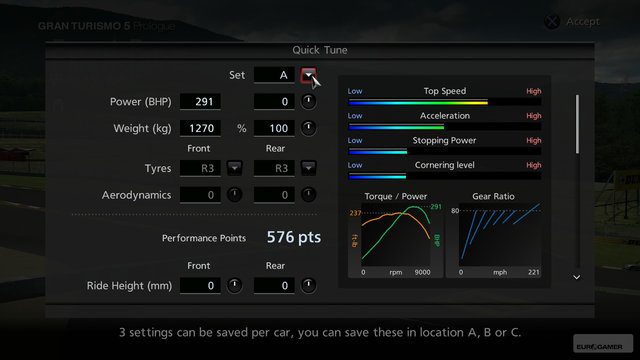
I liked how in GT4, They used real engine tuning,[...]
Are we talking about the same game?
In my copy of GT4 (japanese version) there were very few cars that responded differently depending on how much and with what they were modified.
For most of them, you could for example (Subaru Impreza STi version III) increase their power from 270 hp stock to 500 hp full tuned and the the only difference was that they were more powerful with almost the exact same power/torque curve shapes.
Sure, on the NA ones that could be fitted with a turbo there were way more differences between NA tuning and Turbo kit. But on those cars, most of the time there was no or very little change in power/torque delivery between a Stage 1 and a Stage 2 Turbo kit. And again, if you stuck with NA tuning, little or no differences between all NA kits. Just more power and torque at all rpms.
Again, you could for example tune several Honda S2000 to about 350 hp naturally aspirated and most of them (excluding the bugged Spoon S2000 race car version and the Amuse turbocharged one) had peak power at around 8500 rpm. If tuning was realistic that would have happened at around 10500-11000 rpm, with significant losses at lower ones (< 4000 rpm).
If you look back at Gran Turismo 1 (PSX) there's been a definite step back in this area of the game, which however, despite everything, seems to have been fixed a bit in GT5 Prologue.
Maybe the reason why most cars in GT3 and GT4 did not respond to tuning how they should have had, was lack of time to correctly model that for each individual car by PD.
Maybe that's the same reason why only 2-3 cars in the game had correctly (kind of, though) modeled automatic gearboxes, or that many cars had incorrect specifications, often by much.