Bring back realistic engine tuning!

  • Thread starter Thread starter shirakawaa
  • 188 comments
  • 25,634 views
Unfortunately for some, I have a feeling that GT5's engine tuning will follow the 90/10 rule.

Build the game for 90% of the demographic, and hope for the best when it comes to the remaining 10%.

Personally, I'll be content with whatever is in place, albeit perhaps not 100% happy with it.

I just want the game.
 
Well, if in GT5P they sorted tuning dynamics out a bit (making it work more like I described in the opening post, even though there's only a simple setting there), then I'm positive that probably in the final game, even if it's probably not going to be as detailed as described in many other posts in this thread, it will at least be more realistic compared to GT3 and GT4.
 
By the way, could you post some screenshots/photos/http links showing how torque curves there change according to the slider setting? I'm curious.


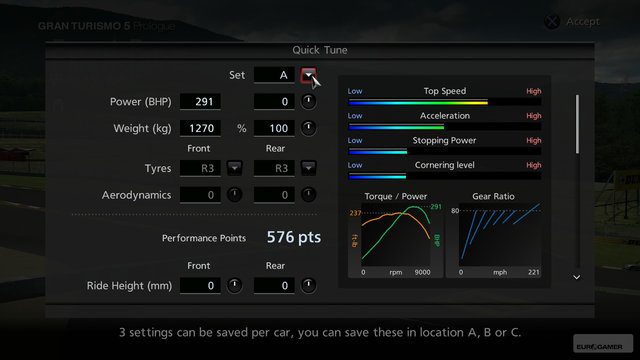
What it looks like. I can take some pics of changes when I get back home
ss_preview_GT5_Prologue_PlayStation_3Screenshots1392655_QuickTune.jpg.jpg
 
Still very hard to use GT4-like charts with no grids and only max values listed :(
I hope they will fix those in the final version, or that they will be better in the career mode.
 
You can eye ball it easy on the graph :)
Not hard to judge, and you can feel when power drops off in the game anyway
 
I was hoping for something more detailed to be frank. While it's true that you can "feel" when power drops, it will never be as precise as setting parameters using the right tools (the chart I posted for example) since you don't actually feel the acceleration with your body. By the the way, the torque chart in the GT5P screenshot there surely doesn't start at 0 rpm as shown! Also, since there's no minimum value listed for torque and power, so other than playing the game, there's no way to know or get a feel of how the values are scaled vertically.

If only I could find some GT1 screenshots from the Parts Set Up screen... you would see (almost) perfection graphed.
 
You can eye ball it easy on the graph :)
Not hard to judge, and you can feel when power drops off in the game anyway
In GT2 you could feel when the power drops off, but they were also nice enough to give you a detailed power chart to go by.


+1:tup: I like to do "testing"!!


Also, yes, I want thrust curves too. power and torque is not as useful without gears, and as gear ratios are a multiplier of torque, then using thrust curves we can see what real shove a car has at the wheels. Dyno curves don't give us the whole picture.


SHIRAKAWA Akira
By the way, speaking of how technical and more realistic GT1 was in certain aspects, does anybody remember how much more detailed and easy to read gear charts and torque/curve charts were there? That's another aspect where there was a definite step down in the last games in the franchise (again, I can't speak for GT5P. Has this been corrected there?). Both charts contain important information for an optimal set-up of the car.

Actually I'd want to see something which combines both charts. It would be useful to set up proper gearing, especially if the engine has a very limited/peaky powerband (again, maybe the guys at PD thought that since power wasn't increasing in a realistic manner in the last games, they dropped detailed gear/dyno charts with helpful grids, intermediate values, etc?).

Something which would show losses would be also useful in determining top speed in advance (here it contains torque at the wheel for each gear. Power would probably be more intuitive for setting up gearing for maximum speed):
 
Last edited:
I always thought GT1 had the best tuning section of all iterations. The gear box setting screen was a breeze to use with the gears map and power/torque curves on the same graph.

It also had a turbo pressure settings screen that permitted to modulate the P/T curves. I almost managed to have a flat line with a stage 4 turbo on lowest pressure.

Anyway, last year, Hip Hop Gamer (whatever his cred is) said GT5 would have a website-like presentation for branded performance parts. If that happens (including what this kind of presentation suggests), The tuning section of GT5 might very well steal the top rank from GT1.
 
I liked how in GT4, They used real engine tuning, For instance,N/A tuning, You could see the bore increase, As well as feel, For instance Honda, A stock Civic SIR (EG6) would rev to 8300 RPM, But when it had a full engine bore plus displacement increase,
It would rev up to 9000 RPM, Or putting a certain turbo on a car, IE srt4 with a stage 2, was actually better then a stage 3, because the stage 2 had better low end and little bit better high end torque, Which is an excellent balance, As stage 3 had more power, But the Torque was near the ends of the RPM, Most obvious turbo tuning was "original turbo" It had pretty high low end and high end torque, So what i'm trying to say, GT4, Had the basics of what could have been hour long tweaking to your hearts content.(Talking about the description of what your buying that scrolls by(With the part you purchase).... It's just to bad you couldn't fiddle with Any of them "internal tunings after you bought the parts...Or put them in one by one, That would have been pretty awesome, To tune adjustable cam gears for better torque....Or in a turbo car, Tune the boost pressure, One game that did offer all that was Tokyo extreme drift 2, That game went in very very deep with realistic engine tuning. Probably the most realistic tuning on a console to date.

I would be a very happy camper if GT5 ends up With TXRD2 Tuning capabilities.
 
Last edited:
I liked how in GT4, They used real engine tuning,[...]

Are we talking about the same game?
In my copy of GT4 (japanese version) there were very few cars that responded differently depending on how much and with what they were modified.
For most of them, you could for example (Subaru Impreza STi version III) increase their power from 270 hp stock to 500 hp full tuned and the the only difference was that they were more powerful with almost the exact same power/torque curve shapes.

Sure, on the NA ones that could be fitted with a turbo there were way more differences between NA tuning and Turbo kit. But on those cars, most of the time there was no or very little change in power/torque delivery between a Stage 1 and a Stage 2 Turbo kit. And again, if you stuck with NA tuning, little or no differences between all NA kits. Just more power and torque at all rpms.

Again, you could for example tune several Honda S2000 to about 350 hp naturally aspirated and most of them (excluding the bugged Spoon S2000 race car version and the Amuse turbocharged one) had peak power at around 8500 rpm. If tuning was realistic that would have happened at around 10500-11000 rpm, with significant losses at lower ones (< 4000 rpm).

If you look back at Gran Turismo 1 (PSX) there's been a definite step back in this area of the game, which however, despite everything, seems to have been fixed a bit in GT5 Prologue.
Maybe the reason why most cars in GT3 and GT4 did not respond to tuning how they should have had, was lack of time to correctly model that for each individual car by PD.
Maybe that's the same reason why only 2-3 cars in the game had correctly (kind of, though) modeled automatic gearboxes, or that many cars had incorrect specifications, often by much.
 
Last edited:
Indeed. I noticed quite a bit how the rather realistic tuning of the first two games went to "the entire torque curve shifts to the right a maximum of 600 RPM for every car in the game." In GT2 and GT1, changing mufflers and the intake could have a dramtic effect on the torque curve depending on what part was installed, but in GT3 and GT4 the only things that changed the torque curve was the NA Tune. Because of how poor the NA tuning was, it actually made turbocharging rather pointless, because turbocharging usually made you lose torque compared to NA tuning, which makes absolutely no sense.

One game that did offer all that was Tokyo extreme drift 2, That game went in very very deep with realistic engine tuning. Probably the most realistic tuning on a console to date.
As much as I like Drift 2, Underground 2 did everything Drift 2 did in regards to tuning first, and Underground 2 did it all better.
 
I remember attempting to tune certain cars in GT1. Putting max tuning on, fiddling with the gears a bit, and then realising the car couldn't even accelerate off the line because there was no low end torque, at all.

I want to be able to do that again :lol:
 
I remember attempting to tune certain cars in GT1. Putting max tuning on, fiddling with the gears a bit, and then realising the car couldn't even accelerate off the line because there was no low end torque, at all.

I want to be able to do that again :lol:

To tell the truth that was a little bit too much exaggerated :)

In GT1 and GT2 engine freewheeling (accelerating in neutral) was poorly simulated when little power was available (in case of turbo engines, at low rpms due to several factors, not only lag). Pretty much any internal combustion engine, especially if fitted with a light flywheel, is able to freely rev with relative ease, no matter what the power available (although you do need some to overcome internal losses, it's only a little amount). Anyway, in real life with such low low-end torque you'd need to use the clutch to start at higher rpms, and also possibly raise the idle speed.

As a result of that, kei cars and especially the Fiat 500 in GT2 took really an unbelievable (and unrealistic) amount of time to rev up, even stock. In real life they do that far quicker. In GT3 and 4 while the physics improved, low-powered cars still were a tad too unresponsive in neutral, felt too heavy, as if engine inertia was tied to engine power or displacement. I hope that will be corrected too in GT5 (again, I don't know about the Keis in GT5P. I know there's the Cappuccino, but I haven't seen it in action).
 
I remember attempting to tune certain cars in GT1. Putting max tuning on, fiddling with the gears a bit, and then realising the car couldn't even accelerate off the line because there was no low end torque, at all.

I want to be able to do that again :lol:

Happened way too much for me in the GTO Twin-Turbo. Sitting there screaming, "come on! 948hp can do more than that! Come on!"
Ahh, good times.
 
I was hoping for something more detailed to be frank. While it's true that you can "feel" when power drops, it will never be as precise as setting parameters using the right tools (the chart I posted for example) since you don't actually feel the acceleration with your body. By the the way, the torque chart in the GT5P screenshot there surely doesn't start at 0 rpm as shown! Also, since there's no minimum value listed for torque and power, so other than playing the game, there's no way to know or get a feel of how the values are scaled vertically.

If only I could find some GT1 screenshots from the Parts Set Up screen... you would see (almost) perfection graphed.

don't know what car that is but this one is from the Tuned Ford GT, showing a 31 unit drop of power from stock, note how the upper end torque has reduced. Lots of bottom end torque, being a big V8 and supercharged

qt1fordgtlmspeciifujixk4.jpg


GTR with power boosted
87949d1218293350-gran-turismo-5-prologue-car-setups-gtr-compare-mm-vs-nick.jpg
 
Thanks for the screenshots.
However, not knowing how the stock torque/power curves are in the game, I'm not sure I can appreciate the difference. That's why I previously asked (if possible!) two or more screenshots showing the same car with different power settings.

The GTR appears to have an insane amount of torque at low rpms anyway.
I take that torque at the beginning of the chart (at idle) is somewhere around 200-220 lb-ft, that's about 300 Nm with virtually no boost on a decompressed 2.6 turbo engine.
Oh wait, maybe it's the new Nissan GT-R rather than the older models (Skyline GT-R)? Then that seems realistic as it's a 3.8 liter V6 and the power boost over the stock configuration isn't that enormous.
 
Last edited:
A video would be better I suppose or an animated gif :)
Battery in my camera is dead

yes it's the R35 GT-R
 
Last edited:
That other game franchise does things in a way that could be nice for GT5.

For example, race intakes and intake manifolds may give you modest power gains, but they also reduce weight. Camshaft setups could raise your rev range in addition to increasing power. Increasing displacement improves low-end power. Raising compression and adding a lightweight valvetrain could improve engine response, especially at high revs.

One key thing is that I'd like to be able to buy the parts, try them out, then remove them if I don't like them or want to try another setup. Being able to sell parts back(get 50% back?) would be optimal.
 
As much as I like Drift 2, Underground 2 did everything Drift 2 did in regards to tuning first, and Underground 2 did it all better.

...wow, people who actually liked the Underground 2 tuning? I'm... I'm not alone anymore! :D

It might not have been a realistic racer, but there's no doubt that UG2 actually had a rather good tuning setup; made sense, really, after all the aftermarket crap you pour into the car :sly:

It would make my day if GT5 had this sort of depth when it comes to tuning.
 
yes it's the R35 GT-R
Ok, then the changes seem believable.

I wonder if in the final version in the career mode we will be able to tweak the engines by lowering maximum power in order to gain low-end torque as it seems to be possible on GT5Prologue. Something like fitting a smaller turbo, reducing intake port size, "torque" cams, or expressely tuned intake/exhaust manifolds, etc.
 
S2000 (Japanese version): 1997 cc, 161 lb/ft, failed.
Civic Type R (FD2 chassis): 1998 cc, 159 lb/ft, failed.
M3 (E90 chassis): 3999 cc, 295 lb/ft, failed.
Integra Type R (DC5 chassis): 1998 cc, 152 lb/ft, failed.
McLaren F1 road version: 6064 cc, 480 lb/ft, failed.

And your point was?

Well, being honest I believe you confused Nm with lb/ft and all of those engines indeed exceed 100 Nm per litre but they all fail to exceed 100 lb/ft per litre. Even F1 engines can't do it as PAPPACLART pointed out.

You're almost partly right. I read the original post and thought 'Wha? There are plenty of 100hp per litre cars!' And I named a few of them out loud. Then I read the post again, quoted the post, made my response and then clicked submit. Then I refreshed and read the post again and said 'Oh crap. That says 100 lb/ft per litre! I'm gonna look so stupid.'

And here we are.
 
Here's the animated gif (refers to Nissan GT-R R35), notice how the power curve and torque curve change when the power is increased. 👍


MVI_0325_MOV.gif
 
I made a video of the Corvette Z06 - going from below stock to just under 700bhp. You can select your units, I'm using NM for torque here.

[YOUTUBEHD]_4TuRHGUvi8[/YOUTUBEHD]
 
Here's the animated gif (refers to Nissan GT-R R35), notice how the power curve and torque curve change when the power is increased. 👍
I made a video of the Corvette Z06 - going from below stock to just under 700bhp. You can select your units, I'm using NM for torque here.

Thanks both of you, now I understand 👍

Good to see that in GT5P the power setting affected values in a realistic manner :)
So most probably there's nothing to fear in GT5 regarding engine tuning realism.
(however I hope that in the final version engine rpms will also increase with tuning, accordingly with what the engine valvetrain allows)
Still, I'd want to see more options than what we've seen so far in previous games.

I'm noticing now though that the chart scale "silently" changes, so it's not always clear (in the Z06 video in particular) if torque at lower rpms actually decreases the more the engine is tuned. The lack of a grid and intermediate values for axes doesn't help.
Also on a turbocharged engine (Nissan GT-R) torque should increase way more than that by fitting bigger turbos/tuning the engine, but probably in GT5P it's balanced in a way that maximum boost remains about the same and its peak simply gets shifted realistically towards higher rpms due to different turbocharger specs.
 
Last edited:
It does go down, use the word "NM" as reference, and you can see the torque move in relation to it
 
It does go down, use the word "NM" as reference, and you can see the torque move in relation to it

Ok, I see.
At the maximum setting, max torque is 775 Nm. Torque at idle appears to be about 1/4 of that which translates to about 193 Nm, which is just slightly better than a standard normally aspirated 2 liter engine.
At the minimum setting, max torque is 574 Nm. However torque at idle appears to be 4/7 of that value which translates to 328 Nm, not to mention the vast gains up to the mid range.

So low-end torque does improve, but it would have been clearer with a grid and more axis values.

Anyway, now the question is: will the final game model these realistic changes for all 1000 cars? Or just the premium ones? I can see this alone taking up much time to be implemented correctly as it doesn't seem to be done with just one or two percentage modifiers. It's more complex than that, and in Prologue (which from what I understand contains Premium cars only) it's probably set up differently for each single car/engine.
 
And, as always, people will pick the one that says "more realistic" without thinking that they may not even understand any of it themselves. The GT1-GT2 stuff was complicated enough. Keep it like that.
 
Anyway, now the question is: will the final game model these realistic changes for all 1000 cars? Or just the premium ones? I can see this alone taking up much time to be implemented correctly as it doesn't seem to be done with just one or two percentage modifiers. It's more complex than that, and in Prologue (which from what I understand contains Premium cars only) it's probably set up differently for each single car/engine.

Unlike modelling, they already have all the engine and torque data, just feed the physics engine and GT5 takes care of it all
 
Back