Physics people helppppp!!!!!!!

  • Thread starter Thread starter N99GT
  • 66 comments
  • 9,958 views
Messages
521
United Kingdom
UK, B'ham
Messages
npanchal / GTP_N99GT
hi there guys!

ive got a question that i cant seem to work out and im hoping that the jolly guys at GTPlanet would be able to help me out!!

heres the question:

131
I is a radioactive isotope of iodine which has a half-life of 8.0 days.
53

A fresh sample of this isotope contains 4.2x10^16 atoms of this isotope.

Calculate:

A - the decay constant of this isotope
B - The number of atoms of this isotope remaining after 24h


NA = 6.02x10^23 mol-1 (avogradro constant)
1MeV = 1.6x10^-13 J

Please help me out!!

the answers are
A- 1.0x10^-6
B- 3.9x10^16

These are the answers that are given BUT i dont know how to work them out :dunce:

EDIT SOLVED THANKS TO THE HELP OF Azuremen AND McRoflSandwich!!!

EDIT 2 Another problem added below! (in red)
 
Last edited:
You should have an equation that relates half-life to the decay constant (lambda) in your text.

Wikipedia also has those equations...

236f752c350e8ff4a3a35a0b098da9eb.png

a94b26e9171e9febf7f027cb670b80b9.png
 
thanks Azuremen....ive managed to work out the 1st question

using
236f752c350e8ff4a3a35a0b098da9eb.png
and then just re-arranging the equation

to get 1.00x10^-6 s-1

still need help with part b :S

oooohhhh do you use that equation that has N=No e -(lamda) x Time ?!

cant find a symbol for the decay constant!!
 
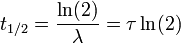
I can have a go at this for you. Its been a year since I last did Radiation in Physics, but I'll give it a shot. For the first one, I used the following formula:
7f7cddb0b90b573d394f26b32d8ed780.png


So you know what your half life is (t1/2). You have to change it into seconds I believe. So 8 days = 691200 Seconds. (8x24x60x60). Now, from that formula you have 691200xlambda = ln 2. Lambda is the decay constant.

So just simple rearrangine gives lambda to equal ln 2 divided by 691200.

This gives a value of 1.0028x10^-6. Which is the answer you gave. I'll have a crack at the second one now. Hope this helps!


EDIT: Heres the second part.

So, for the second one. You need to be using the formula:
3b22fcb9c9d633098a10c9dfbfbe8d36.png


N0 is the initial amount of the substance that will decay.
N(t) is the amount of the substance that hasn't yet decayed.
t1 / 2 is the half-life.
Lambda is the decay constant.

So just plug in your values from this.

N = 4.2x10^16 x e^(1x10^-6 x 86400) Remember I've converted the 24 hours into seconds again.

This gives you an overall answer of 3.85x10^16. Which rounds up to the answer you gave.

Any more questions or need me to expand on anything I've done, feel free to ask, I'll try my best to answer them.
 
Last edited:
:dopey:!!!
i was trying that but i was using 24 instead if the 86400!! argh!

thanks buddy!! and yes i have another question for you =D is there an equation that link both mass and the number of atoms together?!

Calculate the number of atoms present in 1.0kg of

226
Ra
88

BTW thanks for taking your time to answer these questions!!!!
 
Sort of. Firstly you have to convert it into Moles don't you. So divide your 1000g by your molar mass. Which in this case is 226. This gives you 4.42 Moles of Ra in your sample.

Now, in each Mole there are 6.02x10^26 atoms. So simply multiply the two together to get your final answer.

Which should be 2.66x10^24. Or at least I think that should be correct, if my memory serves me correctly... Do you have the answer for this one too?
 
Sort of. Firstly you have to convert it into Moles don't you. So divide your 1000g by your molar mass. Which in this case is 226. This gives you 4.42 Moles of Ra in your sample.

Now, in each Mole there are 6.02x10^26 atoms. So simply multiply the two together to get your final answer.

Which should be 2.66x10^24. Or at least I think that should be correct, if my memory serves me correctly... Do you have the answer for this one too?

haha spot on!!! yerh the answer in the book shows 2.7x10^24!

you remember quite a lot if you haven't done this sort of thing in a year!
Thanks!!

PS can i PM you if i have anymore problems?! your better than my teacher :lol:!!!
 
haha spot on!!! yerh the answer in the book shows 2.7x10^24!

you remember quite a lot if you haven't done this sort of thing in a year!
Thanks!!

PS can i PM you if i have anymore problems?! your better than my teacher :lol:!!!

Haha, I'm suprised at how much I do remember to be honest :p

Sure, feel free. I'll try to help where I can :)

Lotta people from Birmingham in this thread, isn't there?

I know I feel left out being from Sheffield :lol:
 
stig's helmet
Haha :lol: never even noticed that, I was wrapped up in attempting to understand what's going on in the thread.

Haha, it does get confusing :p

By the way, if theres any other parts of physics that you're stuck with then just ask. My knowledge isn't just limited to radiation lol. I'm guessing this is for A-Level?
 
I see. Physics in Amurr'ca is usually just classical mechanics and then electricity and magnetism. Then you have all the crazy astrocriminal stuff but you don't have to be a space terrorist to do half life calculations.
 
I see. Physics in Amurr'ca is usually just classical mechanics and then electricity and magnetism. Then you have all the crazy astrocriminal stuff but you don't have to be a space terrorist to do half life calculations.

To be honest, that's very similar to what we do over here. But we have radiation thrown in there too.


Even if you're a Blade, you're never too far from a Sheffielder on GTPlanet...

Nah, I'm not a blade. Never really been one for football to be honest.
 
Last edited:
Yerh its for a2 level physics and the unit is about nuclear and thermal physics and also a optional unit and in my case its turning points in physics such as the discovery of the electron. And its my final exam is on Monday so its all the last minute questions!! thanks btw ill PM you when i come across a topic that im not sure on!
 
this time the problem that i'm having is with Nuclear Energy and change in mass (E=mc2 and Q=deltamc2)...basically the book that im using shows examples BUT i dont know how they get some of the figures :(

1 - A sealed torch that radiates 10W of light for 10h (=36'000s) would lose 0.36Mj of energy (= 10w x 36'000s). Its mass would therefore decrease by 4.0x10^-12Kg (=0.36MJ/c2) An insignificant amount compared to the mass of the torch.

the bit im not getting in that is where is says "Its mass would therefore decrease by 4.0x10^-12Kg"


2 - A car of 1'000Kg mass that speeds up from a standstill to 30ms-1 would gain 450kJ of Kinetic Energy so its mass when moving at 30ms-1 would be 5.0x10^-12Kg (450 kJ/c2) more than the when it was at rest

same problem here...how are they getting to the 5.0x10^-12Kg?!!


3 - An unstable nucleus that releases a 5MeV gamma photon would lose 8.0x10^-13J. Its mass would therefore decrease by 8.9x10^-30Kg (=8.0x10^-13 J/c2

and in this one i pretty much dont get the whole thing :dunce:.
The answers are probably right there but i cant seem to see how and where they get these figures from! Can some please point out in 3 of the examples of how they get the mass difference and so on!

Thanks very much!!

P.S. the small '2' indicates a square
 
"c" is a constant - the speed of light in a vacuum - equal to 299,792,458 m/s.

Since energy = mass x the square of the speed of light in a vacuum, mass = energy/the square of the speed of light. They tell you that in the examples - 4.0 x 10^-12kg (=0.36MJ/c^2); 5.0 x 10^-12kg (=450kJ/c^2); 8.9 x 10^-30kg (=8.0 x 10^-13 J/c^2).

Just to show you,

0.36MJ = 360,000J
360,000/(299,792,458 x 299,792,458) = 360,000/89,875,517,873,681,764 = 4.0 x 10^-12kg

Try that again with the other two examples.


"Delta" means "change in". So it's pretty much the same thing, except that you're not calculating the innate energy in a given mass (or the innate mass of a given amount of energy), but how much energy and mass change with relation to each other.
 
Gee, I missed this thread! I do Engineering so I need to know all this. Lets see if I can help out when it's needed.
btw, when referring to c, use 3x10^8 instead of it's actual value, unless otherwise stated in the question
 
@ ECGadget - this is nuclear physics though...what sort of engineering are you doing

@madmike1986 - haha if reading gave you a epic brain ache....try working it out! lol my brains about to explode!
 
I am doing Aerospace Engineering, but I have A Levels in Physics and know Astrophysics and Nuclear Physics too.
 
I am doing Aerospace Engineering, but I have A Levels in Physics and know Astrophysics and Nuclear Physics too.

ohh...sounds hard :scared:!!!! glad i didnt apply to that course at uni! :lol:
 
lol, it's more common name is "Rocket Science" but it's fun... I mean, my area's of knowledge really are in computers and programming, and in space. But I know enough Nuclear physics too and Mechanics and dynamics. Electronics is the only thing I don't like much, but I know enough to get through.
 
lol, it's more common name is "Rocket Science" but it's fun... I mean, my area's of knowledge really are in computers and programming, and in space. But I know enough Nuclear physics too and Mechanics and dynamics. Electronics is the only thing I don't like much, but I know enough to get through.

wow! is it me or are you a modest person?!
 
I am not actually sure how to answer that question. Um... I try not to tell people what I know, unless they ask or need help on it... I am not sure if that is modest, but it is just what I feel is right.
 
But yeah, if you do need physics help, I am available. Physics or Computers, and some Chem too. But never ask Bio, I suck at it. lol
 
Back