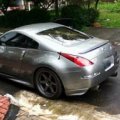
I am not the biggest expert in this, but I would say that a wing would surely help no matter what? Weather for example its a BTCC Honda Civic (FF) or a BMW 320si (FR), the same basic rules apply that when your going forward your vehicle going through the air, and that a wing stabilizes the rear of the car. It pushes the whole car down.
Pretty much. All fours tires contribute to cornering.
In an FF (which naturally would understeer due to the front heavy layout or front engine and front wheels driving), the wing might make the understeer worse. If the point of it is to keep the car on the ground and stabilize the rear of the car, then that "tightening up" effect of the rear of the car will make the whole car harder to steer, increasing understeer as a result? That's why (as mentioned earlier) an FR would naturally be slower, the drive and weight transfer from the rear wheels would make it handle better, even if it had the same wing.
Two things; FF doesn't only understeer. They can oversteer, massively. Lift off oversteer is a big problem for FF because if the weight transfer to the front is severe enough, the rear tires basically have no traction, and they aren't alligned perfectly straight with the direction the car is going, they'll slide around until they end where they shouldn't be, which sometimes results in the front wheels being ahead of the rears. A rear wing will make it harder to lose grip on the rear end.
Secondly, if you put downforce at the rear, you can also put some at the front to maintain whatever balance you want. Usually you want a specific balance that is best for your car, so if you add x amount of downforce in the front/rear, you need to add y on the opposite end to keep the car driveable. If you want max downforce, a rear wing is necessary, even on a FF car.
in FF cars I think the wing would help the most in deceleration, when the car's weight is shifted foward, onto the motor/ FWD. The wing created drag on the rear, pushing the rear end down. RWD cars have LSD torque in the rear end to help plant the rear, FWD's dont...
Drag from a fixed wing doesn't help the braking as much as the added downforce does. It's the extra tire grip that lowers braking distance. More importantly though, FF cars benefit from downforce like all other cars do. Acceleration, cornering, and braking can all be enhanced. The latter two are where the rear wing plays a role.
The size of the rear wing makes us think that it produces a lot of downforce, but the reality is that the rear wing needs to be huge to be effective, because the airflow is disturbed when it reaches the rear. A front wing (like on F1 cars) can be much smaller because the airflow is undisturbed, so a smaller surface is required to be effective.
This isn't always true. Front wings are usually more efficient because of ground effect. As for the rear wing, they don't have to be very high up or very large to get clean air. When you factor in the Coanda effect, even moderately large portions of "disturbed" air can interact with the wing without totally disabling its ability to produce downforce.
This images shows the velocity of the air down the center of the car. The air is laminar, or clean, everywhere except for two places; the wake behind the car and the boundary layer, which is the thin layer of air just above the surface of the car (it's colored blue/green). You can see that the wing can be fairly low without being stalled by bad air off the car. Size only matters in determining how much lift/drag you're going to make.
that plus the wing size is related to the speed at which it will be effective. Large wings are good when cornering, when speed is at a minimum. Take the Pikes Peak hill climb for example. The wings used in that event are monsters.
You're right that the larger the wing, the earlier a car of a certain size will feel its effect. Large wings aren't better at cornering though. LMP's corner as much as Hill climb cars do, but they have smaller wings. Despite the smaller wing size, LMP's make as much downforce, or more downforce, over the course of the race than the hill climb cars do. It's because they typically drive at high speed. If you mounted massive wings on LMP's, their top speeds would plummet to numbers you could reach with a modestly powerful family car. Finding the right wing size for a given application is a challenge, and it's one of the time consuming parts of aero engineering.









 If there were no PP limitations and tuning was wide open, I'd probably have a wing on the BTR and Yellowbird.