Sony Honda Mobility Afeela 1

  • Thread starter Thread starter ProjectWHaT
  • 344 comments
  • 54,498 views
@Baka_Marimo: Humans can also be systematically improved, in a considerably cheaper, faster and less wasteful way: drivers' ed.
Look, I’ll be frank: There’s no way you genuinely believe what you’re saying here. Your distrust of governments already shows that you have a clear understanding of the less savory sides of human nature. And while I personally don't share that specific sentiment, your thinking actually confirms that the kind of large-scale improvement in driver behaviour you are suggesting is virtually impossible. Telling people to put their phones down has neither ever changed anything, nor will it do so in the future. It's reasonable to assume that you are making this statement while being fully aware of that, which makes that argument hard to take seriously (to put it mildly). Or to put it more directly: For someone so distrustful of a relatively small collection of people called "the governemnt", you seem to put a hell of a lot of trust in the driving ability of millions of complete strangers.

We’ve known for decades that distraction, fatigue, impairment, and emotional driving are major causes of accidents. You can’t flip a switch and turn off someone’s emotions after a bad argument, or guarantee they’ll never be distracted because something is going wrong in their life, or ensure they’ll never take risks due to ego or intoxication. If better education or encouragement of responsible behaviour were viable solutions, those problems wouldn’t still be as widespread as they are. Human behaviour is simply not controllable at scale. People will always get behind the wheel tired, stressed or overconfident. They’ll make mistakes or have bad days. And even if some individuals do improve through experience, that progress resets with every new driver getting their license.

Human driving only ever improves individually, inconsistently and temporarily. Never systematically. Autonomous cars on the other hand, don’t have those human failure modes to begin with. Plus, even when something does go wrong, it can be analyzed and fixed across the board. Therefore it’s not realistic to frame this as a problem we can solve by just fixing people. That’s the one variable history has consistently shown is not controllable at scale.
 
Last edited:
Look, I’ll be frank: There’s no way you genuinely believe what you’re saying here. Your distrust of governments already shows that you have a clear understanding of the less savory sides of human nature. And while I personally don't share that specific sentiment, your thinking actually confirms that the kind of large-scale improvement in driver behaviour you are suggesting is virtually impossible. Telling people to put their phones down has neither ever changed anything, nor will it do so in the future. It's reasonable to assume that you are making this statement while being fully aware of that, which makes that argument hard to take seriously (to put it mildly). Or to put it more directly: For someone so distrustful of a relatively small collection of people called "the governemnt", you seem to put a hell of a lot of trust in the driving ability of millions of complete strangers.

We’ve known for decades that distraction, fatigue, impairment, and emotional driving are major causes of accidents. You can’t flip a switch and turn off someone’s emotions after a bad argument, or guarantee they’ll never be distracted because something is going wrong in their life, or ensure they’ll never take risks due to ego or intoxication. If better education or encouragement of responsible behaviour were viable solutions, those problems wouldn’t still be as widespread as they are. Human behaviour is simply not controllable at scale. People will always get behind the wheel tired, stressed or overconfident. They’ll make mistakes or have bad days. And even if some individuals do improve through experience, that progress resets with every new driver getting their license.

Human driving only ever improves individually, inconsistently and temporarily. Never systematically. Autonomous cars on the other hand, don’t have those human failure modes to begin with. Plus, even when something does go wrong, it can be analyzed and fixed across the board. Therefore it’s not realistic to frame this as a problem we can solve by just fixing people. That’s the one variable history has consistently shown is not controllable at scale.
I’ll just like to add that mass consumer adoption of motor vehicles was never going to be a solution to transportation needs relative to population growth.

The amount of variables at play when driving is so complex that it comes down to sheer luck that a person arrives to the destination unharmed, and those variables compound in danger with speed. From the NHTSA , in 2024 there were 39,345 automobile deaths in the US alone, which physical injuries likely eclipse that number.

Metro areas in the USA where more than 5% of population uses public transit to get to work​


1774753803678.webp


There’s no way we can control for the millions of people who commute by car each day. The only way to reduce the amount of accidents on the road is not through drivers education programs, it’s simply by getting people off the road in general, or in this case, into more automated vehicles (just build more rail or add rapid bus transit?).

There have been numerous studies that show people will use public transportation if it were accessible and provided service near their jobs.

I find it really interesting how I came across this comment in a thread on a weird EV; I spend a lot of time doing urban research and studying transit systems.

Inb415minutecities
 
Do you have any sources?

Where did you hear that autonomous cars are becoming mandatory?
Follow your own advice: do your research. I actually wouldn't know autonomous vehicles are becoming mandatory had I not conducted an experiment on Google's AI. My experiment actually started from why I find the 2011 BMW Z4 ugly - the AI then mentioned that the newer "bunny-teeth" BMW grille was designed specifically to accommodate autonomous systems and bam, it said they 're becoming mandatory. So maybe you 'd want to ask Google's AI for its sources instead.

@M Stark: There 's no "inevitable phasing out of combustion engines", only outdated legal mandates to do so as a result of the EV lobby. And I 'm not a "he". Second time you 're quoting me and making the same mistake.

@Baka_Marimo: Better education overall actually is a viable solution. That 's a big reason why I ended up not trusting governments: they don't necessarily choose the most viable solutions. However this comes in stark contrast to what most people I know of tend to do, including my very self, so we can't just blame it all on "human nature". Actually it 's kinda obvious that any sane human would want to go for viable, efficient solutions. Giving up everything to machines is way too wasteful to be viable, it probably isn't even doable, there 's only a finite amout of resources. I know recycling is a thing, but... in Greece most likely everything ends up on the garbage fields and never gets recycled.

@phillgt2002: That 's just an admission of how badly the USA government has messed up in terms of drivers' ed, as well as their vehicle-related laws, deliberately creating the holes that led to the SUV trend rather than imposing strict segment limits. Here 's what should have been done instead on the latter front. But first, some critical definitions.

Width: the distance between the outer points of the tyre contact patches on the road. If there 's a difference between front and rear width, the smaller one is taken into account. This difference must not be greater than 2% of the smaller width.

Height: measured from ground level to the vehicle's highest point, including any antenna attached to it. The suspension must be set to the same ride height as will be available on the market.

Weight: wet weight, including half a tank of the primarily suggested fuel and a 75Kg driver.

And now the segment limits.

K (small cars): length up to 3400mm, width 1700-1724mm, height up to 1400mm, weight up to 700Kg.
A (small family cars): length 3401-3750mm, width 1725-1749mm, height up to 1400mm, weight up to 800Kg.
B (average family cars): length 3751-4050mm, width 1750-1774mm, height up to 1400mm, weight up to 900Kg.
C (large family cars): length 4051-4300mm, width 1775-1799mm, height up to 1400mm, weight up to 1000Kg.
D (very large family cars): length 4301-4500mm, width at least 1800mm, height up to 1400mm, weight up to 1100Kg.
E (giant family cars): length 4501-4700mm, width at least 1800mm, height up to 1350mm, weight up to 1200Kg.
F (presidential limousines): length 4701-4900mm, width at least 1800mm, height up to 1350mm, weight up to 1300Kg.

Sports cars of segments K-C may exceed the width limit if necessary, but are still confined to the length, height and weight limits of their segment. Hypercars may exceed the length limit of segment F, but are still confined to its height and weight limits. Anything that doesn't comply with these limitations is a lorry and must be limited to a top speed of 80Km/h (around 50mph).

For the end, just a small reminder. Remove complexity, add lightness.
 
Follow your own advice: do your research.
Provide your sources and I'll take a look at it. I don't know where you have found your information so I can't check it if you don't want to provide it. If you have a hard time finding sources to back up your claim then perhaps it's not as well-founded as you first thought.
I actually wouldn't know autonomous vehicles are becoming mandatory had I not conducted an experiment on Google's AI. My experiment actually started from why I find the 2011 BMW Z4 ugly - the AI then mentioned that the newer "bunny-teeth" BMW grille was designed specifically to accommodate autonomous systems and bam, it said they 're becoming mandatory. So maybe you 'd want to ask Google's AI for its sources instead.
Google is not a source. Google is a search engine and can help you find sources. Google AI can help you by pointing in a direction where you're likely to find information, but the text that it generates is based on a probabilistic language model (what is the most likely next word in the sequence) and is not necessarily true.
 
Provide your sources and I'll take a look at it. I don't know where you have found your information so I can't check it if you don't want to provide it. If you have a hard time finding sources to back up your claim then perhaps it's not as well-founded as you first thought.

Google is not a source. Google is a search engine and can help you find sources. Google AI can help you by pointing in a direction where you're likely to find information, but the text that it generates is based on a probabilistic language model (what is the most likely next word in the sequence) and is not necessarily true.
I know Google is a search engine. Its AI is basically a different way of result presentation. The generated text however was particularly specific about these systems becoming mandatory, mentioning about companies guaranteeing a market for their sensors and it even listed some company names, I just don't remember them now. So maybe if you repeat my experiment you will find what it stumbled upon? Or do you want me to repeat the experiment and just give you the company names it will mention this time?
 
I know Google is a search engine. Its AI is basically a different way of result presentation. The generated text however was particularly specific about these systems becoming mandatory, mentioning about companies guaranteeing a market for their sensors and it even listed some company names, I just don't remember them now.
You don't seem to be acting like you know it, because you do place an awful lot of trust in something that AI has told you, without having verified that it's true. Large language models can be super specific about the details, even capable of citing sources. The problem is that if you scratch beneath the surface you will often find that the sources were made up or that they didn't support the claim the AI made. AI will often generate its text in such a way that it looks more trustworthy than it actually is, so you always have to verify that what it's telling you is actually the truth.
So maybe if you repeat my experiment you will find what it stumbled upon? Or do you want me to repeat the experiment and just give you the company names it will mention this time?
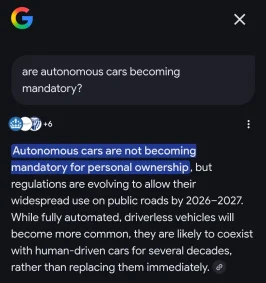
I asked Google if autonomous cars are becoming mandatory and it said no. Where does that leave us now?
Screenshot_20260329_115356_Chrome.webp
 
Follow your own advice: do your research. I actually wouldn't know autonomous vehicles are becoming mandatory had I not conducted an experiment on Google's AI.
And you still don't: no country on Earth has any legislation making any kind of autonomous vehicle mandatory. Most are struggling even with making higher-level autonomy (L4-5) permissible due to liability. Source: I'm a motoring journalist.

You've either confused about what Google's search engine AI is telling you, or it's hallucinating because it's basically predictive text and draws data from idiots on social platforms without judgement on the fact that they're idiots.

Some advanced driver assistance systems (ADAS) that can be considered low-level autonomy (L1, L2) are compulsory to achieve high scores in independent industry safety testing - the various NCAP tests, for example - but this is not legislative and it's not mandatory to test well in order for a car to be on sale.
 
That 's just an admission of how badly the USA government has messed up in terms of drivers' ed, as well as their vehicle-related laws, deliberately creating the holes that led to the SUV trend rather than imposing strict segment limits. Here 's what should have been done instead on the latter front. But first, some critical definitions.

Width: the distance between the outer points of the tyre contact patches on the road. If there 's a difference between front and rear width, the smaller one is taken into account. This difference must not be greater than 2% of the smaller width.

Height: measured from ground level to the vehicle's highest point, including any antenna attached to it. The suspension must be set to the same ride height as will be available on the market.

Weight: wet weight, including half a tank of the primarily suggested fuel and a 75Kg driver.

And now the segment limits.

K (small cars): length up to 3400mm, width 1700-1724mm, height up to 1400mm, weight up to 700Kg.
A (small family cars): length 3401-3750mm, width 1725-1749mm, height up to 1400mm, weight up to 800Kg.
B (average family cars): length 3751-4050mm, width 1750-1774mm, height up to 1400mm, weight up to 900Kg.
C (large family cars): length 4051-4300mm, width 1775-1799mm, height up to 1400mm, weight up to 1000Kg.
D (very large family cars): length 4301-4500mm, width at least 1800mm, height up to 1400mm, weight up to 1100Kg.
E (giant family cars): length 4501-4700mm, width at least 1800mm, height up to 1350mm, weight up to 1200Kg.
F (presidential limousines): length 4701-4900mm, width at least 1800mm, height up to 1350mm, weight up to 1300Kg.

Sports cars of segments K-C may exceed the width limit if necessary, but are still confined to the length, height and weight limits of their segment. Hypercars may exceed the length limit of segment F, but are still confined to its height and weight limits. Anything that doesn't comply with these limitations is a lorry and must be limited to a top speed of 80Km/h (around 50mph).

For the end, just a small reminder. Remove complexity, add lightness.
Was this punched into AI as well? I’m trying to follow what this is trying to say, and I’m assuming it’s a version like the Japanese vehicle classification system? If so this is missing any mentioning of engine displacement and restrictions.

Either way, I can’t continue this argument in good faith. I’m trying to understand where SUVs come into play, because vehicle safety, while dependent on mass and size of the vehicle, is mostly about overall infrastructural safety and policy.

U.S. roads do not have as many safeguards with rates of speed that do not favor the human factors of driving and traffic calming infrastructure that discourage speeds that vehicles cannot handle. That is mainly down to the pure form of the road or street, often relating to scale (width, length, curvature).

Driver’s Ed has nothing to really do with this. Germany has some of the most intensive and strict driving training in the world in order to obtain a license; and despite being the 1:1 inspiration of the Federal Highway Act of 1956, they have done well to address driver’s safety by binding safety standards and responsibility to motor vehicle operators to law.

This is about policy, not the individual. Individuals can’t truly escape the grasp of poor policy, they just adjust; and in this case, people have adjusted through the purchasing of SUVs and larger vehicles in general in the belief of austere safety.

(suvs aren’t popular just because; their inception was through the usage of loopholes around restrictions that were imposed during the U.S. oil crisis in the 1970s and lingering effects in the 1980s - I advise you to do some reading up on how the oil crisis impacted vehicle development and safety and how we eventually ended up in the predicament we are in now)
 
Last edited:
There 's no "inevitable phasing out of combustion engines"
Strictly speaking for the everyday commuter, yes there is. Even if it doesn’t end up being EV’s that take their place, it will be something else. Combustion engines will continue being relevant for the hardcore enthusiasts, hobbyists, certain professionals, and (maybe) motorsports.

As for autonomous vehicles, there’s no evidence they’re becoming the standard. Let alone mandatory.
 
So you don't even care about turning the ESP off on the Tesla. You 're not convincing me you "lean on it" enough to even learn it. Sure it is quick on a straight line, but I 'm more of a momentum manager than a straight line speeder and I don't like the idea of having to do this on such a heavy car with all that polar inertia. The main masses of an ICE vehicle (if it 's designed properly) are all within the wheelbase and low enough to achieve a good centre of gravity, resulting in much smaller polar inertia than any EV. Now if an EV can achieve a marginally lower centre of gravity, that 's about it. And then there 's the gearing. Regardless how many claims may be made that "EV motors are super precise", the exclusively long gear ratios they 're attached to are a no-go. And, if despite all this the Model 3 is one of the best cars you 've ever driven on corners, well this goes to show what you should expect when most manufacturers focus so much on comfort even at the detriment of safety. Too much comfort is bad for health anyway.

@eran0004: Just the fact that you rely on "hearing about the lobbying" is enough for me to understand you 're not ready for this sort of matter yet. I suspect that, in the real world, you 're not even legally aged to drive. This is also apparent in how you think it 's so easy to "design cars to be autonomous". Well no, it 's been proved impossible. Autonomous vehicles rely on sensors, which are bound to have large blind angles, as well as do an awful job (or no job at all) in bad weather. And then there 's the issue of social hints (if this is the correct term in english). We humans will see a loose ball and predict a kid will carelessly run to pick it up - the machine cannot do that, so it will react too late or not at all, thus killing the kid. And then you won't be able to stop. The machine will keep going at all costs. But even if you were to disregard these safety concerns, why accept something that will over time make us lose yet another skill? Why rely on machines for literally everything? Why be so lazy?


1)Of course, driving style is an issue with most people. A properly engineered car doesn't mean much if it 's driven by someone with inadequate driver's ed and no mechanical empathy. Still, different cars are good at different things. These two facts don't cancel each other.

2)You 're confusing automatic parking for full-on autonomy. While I don't support automatic parking either, I can tell for sure that making a car completely autonomous is a different story. I mean, how fast do you go when parking?

3)The two main parties in the USA are controlled by the country's MIC, so there 's no real choice. It 's like PASOK and ND in Greece, with SYRIZA being the old PASOK for a while: albeit a different party appears to govern, the policies applied usually follow the same trajectory for the worse.

I left this as I didn't think it was on topic, but since it's still going in some form that barely relates to the Afeela, I'll have at it.

The issue of polar inertia, which seems to be your bugbear with EVs, is just as misguided as your comment about the mythical long gear ratios they are supposedly attached to, because EVs naturally have a low polar moment of inertia due to the batteries being low and in the centre of the car. High polar moments tend to be front-engined ICE cars, since their weight sits anywhere from just behind the front axle to above or slightly beyond it.
 
Last edited:
I also adore insinuating that there are some kind of evil lobbyers out there vying to make electric cars the dominant form of transport as if the automotive industry hasnt been doing that with ICE since its inception.
 
Last edited:
I also adore insinuating that there are some kind of evil lobbyers out there vying to make electric cars the dominant form of transport as if the automotive industry hasnt been doing that with ICE since its inception.
Plus the fact that oil companies themselves have been lobbying for their own interests verses other 'fuels' for well over a century.

Car manufacturers would be largely indifferent to whether they produce ICE vehicles or EV vehicles - as long as they're given enough notice to regulation changes and those regulations are set in stone enough for their investments in new tech to be worthwhile. Oil companies only sell oil and oil by-products so have much more to lose/gain.
 
Car manufacturers would be largely indifferent to whether they produce ICE vehicles or EV vehicles - as long as they're given enough notice to regulation changes and those regulations are set in stone enough for their investments in new tech to be worthwhile.
We've seen that writ large in Europe too. The wild uncertainty over whether pure-ICE cars would be regulated out by 2030, 2035, or 2040 resulted in a lot of chaos, because that's well within the window of development for mainstream products. A typical car is planned eight years before we see it, and if manufacturers don't even know what they're going to be allowed to make it move they can't plan.

Which neatly takes us back to the Honda Zero platform, and Honda's own cited reasons for sacking off the whole thing after spending billions modernising the plants and workforce in Ohio to make the cars there. As well as losses in Asia from being undercut by Chinese products, the... ahem... "dynamic" nature of current regulatory framework in the USA has meant that the company would rather take a $16bn hit and its first ever loss in 70 years (something excruciating for its C-suite) by withdrawing rather than sinking more money into something that might be incentivised one minute and potentially even banned the next.
 
I think this Sony/Honda story is to do with EV
Your article is paywalled but... yes? Why wouldn't it be?

Honda cancelled its entire new EV platform in the USA, as a result of component tariffs and the end of EV incentives and subsidies in the USA, resulting in a $16bn loss and the cancellation of Sony's planned EV which used that EV platform.
 
You don't seem to be acting like you know it, because you do place an awful lot of trust in something that AI has told you, without having verified that it's true. Large language models can be super specific about the details, even capable of citing sources. The problem is that if you scratch beneath the surface you will often find that the sources were made up or that they didn't support the claim the AI made. AI will often generate its text in such a way that it looks more trustworthy than it actually is, so you always have to verify that what it's telling you is actually the truth.

I asked Google if autonomous cars are becoming mandatory and it said no. Where does that leave us now?
View attachment 1524633
Directly they 're not, but step by step they are. That 's where your iteration of my experiment "leaves us now".

@Famine: this doesn't change that all new cars now in the EU are equipped with autonomous systems (such as ESP and pre-collision braking). I once talked with an employee at the dealership about the matter (after the experiment I mentioned) and he told me these systems are "sadly mandatory". So it 's not just AI guessing they might become mandatory in the future.

@phillgt2002: the part about the SUV trend itself was revealed by AI indeed, but I 'd not mention it anywhere if it didn't tie well with what I 'm seeing of the automotive world. The segment limits idea though is all my own. I deliberately avoided displacement and power limits, replacing them with height, width and weight limits. You don't need 9000ccm and 800bhp if the car is lightweight and properly sized. Then you mention "austere safety", but there 's a problem with this factor: perceived safety is the greatest danger.

@M Stark: not sure what else could theoretically take the place of ICEs, as there is the option of Gen2 ethanol for them.

@VXR: EV batteries are not as small as you think. They do sit low in the car, but take up large part of its length and width. Batteries will never get the density necessary to power a car on their own. And, exactly because of this, I assume driving position height may also be an issue with EVs. I want to feel I 'm sitting IN the car, not ON it. Anyway, most of what you mention is just a result of most manufacturers trying to make cars for the casual, careless driver. Better cars than that can (and must) be made.
 
@Famine: this doesn't change that all new cars now in the EU are equipped with autonomous systems (such as ESP and pre-collision braking).
They are not.

And, as I mentioned, these are ADAS and at most L1/L2 (same as self-parking, adaptive cruise control, and frankly even regular cruise control), required to pass certain safety tests like NCAP - which are not compulsory - rather than L4/L5 which comprises actual autonomous driving.

I once talked with an employee at the dealership about the matter (after the experiment I mentioned) and he told me these systems are "sadly mandatory".
Car dealership in not knowing what the hell they're talking about shocker.
So it 's not just AI guessing they might become mandatory in the future.
Yes, it is.
 
They are not.

And, as I mentioned, these are ADAS and at most L1/L2 (same as self-parking, adaptive cruise control, and frankly even regular cruise control), required to pass certain safety tests like NCAP - which are not compulsory - rather than L4/L5 which comprises actual autonomous driving.
OK then, name for me one car, currently available in Greece's market, that has no autonomous systems (not even L1).
 
OK then, name for me one car, currently available in Greece's market, that has no autonomous systems (not even L1).
One? Virtually any small hatchback (A/B-segment) and crossover (B-CUV) comes with a model sporting no autonomous systems.

1774881370280.webp


Although I'm unfamiliar with the precise trim levels offered in the Greek new* car market (and it's weird that you'd demand that), you can try entry-level models of the Dacia Sandero, Kia Picanto (or Hyundai i10) or Skoda Fabia.

*Always fun to consider that these "mandatory" arguments always omit the existence of the used car market. No legislation exists anywhere I'm aware of to get rid of second-hand cars of any age, pulling the rug out from under the concept that EVs and higher-level autonomy will become mandatory to drive...
 
@VXR: EV batteries are not as small as you think. They do sit low in the car, but take up large part of its length and width. Batteries will never get the density necessary to power a car on their own. And, exactly because of this, I assume driving position height may also be an issue with EVs. I want to feel I 'm sitting IN the car, not ON it. Anyway, most of what you mention is just a result of most manufacturers trying to make cars for the casual, careless driver. Better cars than that can (and must) be made.
What does this mean?
 
Are we still waiting on solid state batteries? Is that the supposed breakthrough EVs need to become more "useful" to the everyday consumer?
SSBs are already in limited use in really small electronic devises, but there are plenty of issues that need addressing before the tech can be scaled up for automotive use, from what i've read. A decade or so seems to be the timescale the experts are suggesting. When they do get there they will be much more energy-dense and charge much quicker, solving the biggest drawbacks EV's currently have - range and recharge time. If EVs essentially get killed off before that point then that tech will probably take much longer to gestate.
 
@M Stark: not sure what else could theoretically take the place of ICEs, as there is the option of Gen2 ethanol for them.
No idea. All I know is the current ICE consumer model makes no sense. It’s archaic and it’s full of well documented disadvantages.

1. Fossil fuel is a finite resource. It’s a logistics nightmare since you need gas stations for refueling. It’s toxic/harmful for the human health and the environment when it’s being burnt out of millions of vehicles, packed like sardines.

2. Engine/transmission complexity and maintenance. People want something that just works so they go from point A to point B, safely. ICEs are not hassle free, period. Brands like Toyota remain consumer favorites not because their cars are a thrill to drive (for the most part) but because they are very reliable.

3. Pollution. I’ve already mentioned fuel fumes which literally make entire cities’ climate like Beijing an uninhabitable smog. The other thing is noise pollution. Engine noise can be fun, but the fact of the matter is the average commuter and surrounding residents deserve a safe and pollution-free environment to live in. The fact is, our beloved ICEs are a detriment to that.

Again, I do expect ICEs to be relevant for decades to come for enthusiasts, certain professionals, and probably some motorsports. So it’s not all doom and gloom.
 
Last edited:
No idea. All I know is the current ICE consumer model makes no sense.
It's scale strongly suggests otherwise.
It’s archaic and it’s full of well documented disadvantages.
Compared to what?
1. Fossil fuel is a finite resource.
Ok.
It’s a logistics nightmare since you need gas stations for refueling.
It's a solved problem (for 70+ years now), not a logistics nightmare.
It’s toxic/harmful for the human health and the environment when it’s being burnt out of millions of vehicles, packed like sardines.
No argument there.
2. Engine/transmission complexity and maintenance. People want something that just works so they go from point A to point B, safely. ICEs are not hassle free, period. Brands like Toyota remain consumer favorites not because their cars are a thrill to drive (for the most part) but because they are very reliable.
ICE engines are a very mature product so I find this pretty meritless. I would fully expected basically any new car to last at least 20 years with proper maintenance. I can't say the same about basically any other consumer product I own.
3. Pollution. I’ve already mentioned fuel fumes which literally make entire cities’ climate like Beijing an uninhabitable smog. The other thing is noise pollution. Engine noise can be fun, but the fact of the matter is the average commuter and surrounding residents deserve a safe and pollution-free environment to live in. The fact is, our beloved ICEs are a detriment to that.
This doesn't mean the business model doesn't make sense, it's that the trade-offs are not being accounted for.
Again, I do expect ICEs to be relevant for decades to come for enthusiasts, certain professionals, and probably some motorsports. So it’s not all doom and gloom.
At this point I don't really know what you're arguing.
 
@FaithJonesFEM have you sat in a Tesla Model 3? The last car I had where I sat that low within it was an E36 BMW. An EV doesn't have to be upright, that's just general market preference for crossovers. Sure, it might be slightly higher to accommodate the batteries, but even with such a low front windscreen height and dashboard, you still feel properly sat in it.
 
Last edited:
@Eunos_Cosmo I don’t doubt the maturity of ICEs but in the end of the day, they’re still ICEs. From a maintenance perspective they’re a pain in the ass and expensive. We’ve got used to them but they are not user friendly at all because they are complex assemblies. In comparison, EVs are already simpler even though they’re still too green.
Another, arguably massive point of friction with ICEs is all the transmission minutia. Cheap trannies quite simply are not fun to drive, period. They are just, functional until they’re not. Cheap manuals suck, cheap autos also suck and they’re more expensive overall, even higher performance trannies are not perfect because there’s always a sacrifice of comfort vs performance.

The argument is ICEs are on the way out and for very good reasons. Their competition is not mature yet, but it’s just a matter of time.
 
Your article is paywalled
.
Thats interesting. The link is paywalled but when clicked on from search engine link it is not paywalled.
Paste "$65 billion ev write off financial times" into duckduckgo search to see the same link address but the article is free to read.
 
Directly they 're not, but step by step they are. That 's where your iteration of my experiment "leaves us now".

@Famine: this doesn't change that all new cars now in the EU are equipped with autonomous systems (such as ESP and pre-collision braking). I once talked with an employee at the dealership about the matter (after the experiment I mentioned) and he told me these systems are "sadly mandatory". So it 's not just AI guessing they might become mandatory in the future.
Your sales person most likely told you the answer he wanted to give you to make a sale, hence the use of "sadly" & the fact you're clearly outspoken about your dislike of said systems.

Source: 10+ years in the dealership industry. Folks learn how to speak to you, they're not always right or wrong. Additionally, just telling you they're mandatory can be seen as vague; are they mandated features by government, or mandatory features the manufacturer wants on all vehicles? (Ex. all Lexus have an auto-dimming mirror, but that is not necessary by law).
 
Last edited:
One? Virtually any small hatchback (A/B-segment) and crossover (B-CUV) comes with a model sporting no autonomous systems.

View attachment 1524860

Although I'm unfamiliar with the precise trim levels offered in the Greek new* car market (and it's weird that you'd demand that), you can try entry-level models of the Dacia Sandero, Kia Picanto (or Hyundai i10) or Skoda Fabia.

*Always fun to consider that these "mandatory" arguments always omit the existence of the used car market. No legislation exists anywhere I'm aware of to get rid of second-hand cars of any age, pulling the rug out from under the concept that EVs and higher-level autonomy will become mandatory to drive...
So I had to specify I was asking about new cars, right. I took it for self-explanatory since cars on the used market are usually in trash condition. And the reason why I asked specifically about Greece is because that 's where I live. So now let's take a look at the models you mention. The most reputable of them all is clearly the Fabia, which has lane assist on all its models, so it 's thrown out of the list. Let's go to the Sandero now: it has ESP and other autonomous systems on all its models, so it also is thrown out. What about the Picanto now? It also has "stability management" systems, two of them no less, on all its models, so it also is thrown out. Last we go for the i10: it has as standard an array of systems, including the Lane Following Assist, so out of the list it goes. What are we left with? Nothiiiiing... Therefore, even if indirectly, something makes these systems mandatory. And it definitely isn't long-term viability of autonomous vehicles. There 's something much darker going on, you have to admit.

What does this mean?
It explains why EVs are so grossly overweight that I don't really count them as cars. Notice how, in my proposed segment plan, the maximum weight limit is 1300Kg when the average EV weighs around 2000Kg or so. And, either because of that or in spite of that, their real-world range is far lower than the real-world range of a same-size ICE car. I don't really care that much what happens on paper, as cars are not driven on paper.

No idea. All I know is the current ICE consumer model makes no sense. It’s archaic and it’s full of well documented disadvantages.

1. Fossil fuel is a finite resource. It’s a logistics nightmare since you need gas stations for refueling. It’s toxic/harmful for the human health and the environment when it’s being burnt out of millions of vehicles, packed like sardines.

2. Engine/transmission complexity and maintenance. People want something that just works so they go from point A to point B, safely. ICEs are not hassle free, period. Brands like Toyota remain consumer favorites not because their cars are a thrill to drive (for the most part) but because they are very reliable.

3. Pollution. I’ve already mentioned fuel fumes which literally make entire cities’ climate like Beijing an uninhabitable smog. The other thing is noise pollution. Engine noise can be fun, but the fact of the matter is the average commuter and surrounding residents deserve a safe and pollution-free environment to live in. The fact is, our beloved ICEs are a detriment to that.

Again, I do expect ICEs to be relevant for decades to come for enthusiasts, certain professionals, and probably some motorsports. So it’s not all doom and gloom.
1)Fossil fuel is a finite resource, but Gen2 ethanol is a renewable resource that does not compete against food availability. Also, ethanol has certain advantages related to ICEs such as the cooling effect, so ethanol engines can be more efficient than suggested by its energy density alone. People will have to give up on the expectation of massive torque at 1500rpm, but no proper car needs massive torque at 1500rpm.

2)ICEs are not hassle-free, but neither are EVs when you 're forced to replace the battery (it will happen sooner than you may think). And as you mention Toyota I did buy one, but... because it 's a thrill to drive for what it cost.

3)EVs don't cancel pollution. They just move it and even amplify it. Electricity somehow is produced, you know. Also, engine noise is not just fun. It 's a safety feature, it helps keep control of the car. As for ICE pollution in the cities, why don't people just walk to their in-city destinations? The problem is made even worse by those who always want to park right outside their destination, which is a massive waste of energy regardless the powertrain. Personally, when I 'm not going to leave the city, I just go on foot.

VXR
@FaithJonesFEM have you sat in a Tesla Model 3? The last car I had where I sat that low within it was an E36 BMW. An EV doesn't have to be upright, that's just general market preference for crossovers. Sure, it might be slightly higher to accommodate the batteries, but even with such a low front windscreen height and dashboard, you still feel properly sat in it.
"General market preference" can very well be manufactured btw. See for example how the EU manufactured a demand for diesel engines somewhere in the 2010s. Driving 4 Answers has done a very informative video on the matter.

@Eunos_Cosmo I don’t doubt the maturity of ICEs but in the end of the day, they’re still ICEs. From a maintenance perspective they’re a pain in the ass and expensive. We’ve got used to them but they are not user friendly at all because they are complex assemblies. In comparison, EVs are already simpler even though they’re still too green.
Another, arguably massive point of friction with ICEs is all the transmission minutia. Cheap trannies quite simply are not fun to drive, period. They are just, functional until they’re not. Cheap manuals suck, cheap autos also suck and they’re more expensive overall, even higher performance trannies are not perfect because there’s always a sacrifice of comfort vs performance.

The argument is ICEs are on the way out and for very good reasons. Their competition is not mature yet, but it’s just a matter of time.
Keep in mind that too much comfort is bad for health. I actually bought the least-comfortable car that was available at the time, and did so on purpose, because all other options felt too comfortable. Manufacturers would do well to cut down on comfort.

Your sales person most likely told you the answer he wanted to give you to make a sale, hence the use of "sadly" & the fact you're clearly outspoken about your dislike of said systems.

Source: 10+ years in the dealership industry. Folks learn how to speak to you, they're not always right or wrong. Additionally, just telling you they're mandatory can be seen as vague; are they mandated features by government, or mandatory features the manufacturer wants on all vehicles? (Ex. all Lexus have an auto-dimming mirror, but that is not necessary by law).
No, I had already bought the car. I went there to get it serviced (else the warranty would be void) and he just happened to have a couple minutes for a chat before the mechanic began working on it.
 
Back