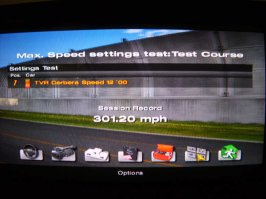
I'm sure he will. Eventually you will be beating eachother by 0.01mph at a time.

A small note on tyre compounds, by the way...
Imagine a rubber ball on a plastic surface. If we roll the ball, it moves easily, but if we try to slide the ball along, it's more difficult.
What we have is 2 concepts called rolling resistance, and sliding friction. Above, the rolling resistance is very low, and the ball turns easily, and the sliding friction is high, because it is difficult to slide the ball along. In a car tyre, these properties are denoted by the tyre compound, and the area with which it touches the ground. The bottom of a tyre actually sits flat on the ground (imagine how a flat tyre looks, then rewind a bit), and this is what gives it its grip. The larger this flat area, the higher rolling resistance is, and as you can imagine with the flat tyre, the harder the wheel is to turn. The sliding friction does not depend on the size of this flat area, it is solely dependant on the material of the tyre and the road surface.
Now, a soft tyre will deform more under the weight of the car, and as a result will have a larger flat area at the bottom. This results in the wheel being harder to turn, due to increased rolling resistance. On the upside though, we increase sliding friction, thus making the car more grippy when turning and accelerating hard. I guess these effects would be similar to how a tennis ball behaves on velcro when compared to the rubber ball on plastic.
In essence, the soft tyre loses driving energy through it making the wheel harder to turn, but reduces the slipping of the tyre against the road. If the tyre is slipping too much, we switch to a softer tyre, but if there's no slipping at all, a harder tyre can be used. Getting the right trade off between the two effects is essential for high speed.
The effect in the tyres is nowhere near as pronounce as the ball/surface metaphor I presented above, but maybe it makes it easier to understand why in a straight line, harder compounds can sometimes be faster.
I need to go experiment...


 ,, I agree with team66 and De about the tyres,, A lot of things depend on the car really,, Anyways you just have to try,,





 👍
👍


 DE 👍
DE 👍
 ..after if i have time i can try ...


 I think I'll wait and see if I-Runner or DE can improve their speeds. DE knows already how fast speed I got..