I'm meaning the torque the engine applies to the driveshaft, in physics all forces have an equal but opposite reactive force.
they would only deform so far, once they are at their limit they won't 'soak up' any more and that limit will be reached in a fraction of a second.
A bit more here as to how it relates to drag racing:
http://www.hardcoremetalworks.com/index.php/tech_articles/drag_racing_chassis_tuning/
Good stuff!

A full system view of the torque reaction between rear axle and the chassis reveals how weight on the drive tires transfers from one side to the other. With the driveshaft spinning counter clockwise, it puts a torque on the rear axle in the same direction. This has the effect of increasing the weight on the left-side drive tire (A.) as it reduces weight on the right-side drive tire (B.) even though the chassis surges to the right (C.) compressing the springs.
Anyway, I'm not in disagreement with the concept. I accept that this occurs, I was disputing its significance in all situations. Obviously with high powered cars, such as dragsters etc., it would be more of an issue - even greater so the lighter the car is, since the differential (weight bias) between the traction wheels would increase relative to the sum over the two, hence increasing the "skew"...
I gave it a go in GPL, and whilst it's hard to ensure the wheels are straight, it does seem to prefer stepping left (engine spins anti-clockwise looking from the rear of the
car).
LFS is a bit simpler, straighten the wheels as per the G-guage, stop, rev it, dump the clutch. It also prefers stepping left, as the engine also rotates anti-clockwise.
In LFS I used the XRT, a 1400 kg, 250 bhp, 255 lbf.ft FR car with a track of 1.6 m (in the pit lane of the oval)
In GPL: Brabham BT11 2.7, a 600 kg, 260 bhp, 240 lbf.ft MR car with a track of 1.4 m (on the main straight at Monza)
Both are low-revving (~7k limit), torquey fours, though the XRT is turbo'ded
The Brabham stepped out slightly more than the XRT, but it barely needed correcting in either case - that is, it was never out of control, just yawed a wee bit (<< 5°). In both cases, turning the wheel by less than this same amount resulted in the effect being canceled. I was using a G25 with rotation set to 540° in both cases, of course the steering angle of the two cars is quite different, being much smaller with the Brabham.
I tried a the Raceabout and the FZ50 in LFS, too - a 250 turbo hp, 800 kg MR car and a 360 bhp, 1450 kg RR car, respectively. Neither stepped out at all, though I didn't expect the former to, as it's engine is transversely mounted.
Taking a 3 ltr '66 Ferrari in GPL, with its 370 bhp, 270 lbf.ft and 700 kg was a different story though - it was quite happy to spin around!

It was still avoidable, and heavily influenced, via the steering input, however.


).


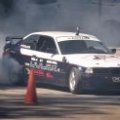





 (although, I am a bit disturbed by the coriolis effect, now!)


