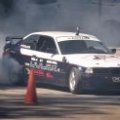
Cars stepping out

  • Thread starter Thread starter cicohipe
  • 155 comments
  • 15,825 views
Its also worth mentioning this 'phenomenon' occurs more in lighter cars where the torque has more influence over the mass of the vehicle.

Big hulks like a AMG Merc' would be more likely to just draw a nice set of 11's down the road (if we had tyremarks :scared: ).

A TVR in this case would be a good test vehicle, low weight, high torque output, front engine, longitudinally mounted driving the rear wheels.

As to why it matters..some people (myself included) enjoy the odd session now and again just messing about on the skidpan.

In fact, that would be a cool add-on, something as simple as being able to place cones on a skid pan allowing you to set up your own auto discipline (cant remember the proper name) course..hours of fun

The word you're looking for, is.................................. Autocross!
 
thats the badger 👍👍👍👍

I knew it was auto_______ but couldn't for the life of me remember what :crazy:

I had a game on the C64 (must be 20yrs ago), that was top-down view (2D obviously) and involved j-turning and handbraking round various courses..was great
 
The best way to tell how good a driving games physics are is to see how they handle at low speeds. That is when the engine is usually using pre-programmed table based logic and you can usually even seen the transition if you know what to look for.

Comparing Forza 2, 3 to GT5P I can tell you right now that Forza has better low speed physics, and the cars actually step out when you launch from a dead start.
 
No one has ever mentioned this that i am aware of, yet it has always bugged me about the GT series. When you launch a car in real life and get a large amount of wheel spin you car's rear end will slide to the left. It always moves to the left and i believe this is something to do with torque transfer through the differential or something. Some games have showed this (Forza being one) but Gran Turismo has never had this, and the main reason this bugs me is it shows a design flaw in their physics engine.

I think if you have a go at GT1 again you will find that depending what car you choose (FR/HP) makes a difference in handling and the amount of wheel spin generated. I remember the Nissan Skyline R34-GTR Road version, but when you go to its race modified version with the Red White and Blue livery it is a beast to control. I remember there being tons of wheel spin whenever trying to get around a corner. So much wheel spin infact that I had a hard time not spinning out everytime I raced on Deep Forest or Seattle. So I dont think you can say that there is a major flaw in its design physics as it was the first of the GT Series but more about the control of the cars that do this.
Now if memory serves me correctly I believe that GT1 had Traction Control and this made no difference for some cars that are FR or MR.

You have to remember that this game is about you being able to control the car with or without the Aids and I think GT1 + GT2 gave good reference on how to control a vehicle that always wants to step out a bit.

But in saying all of this it is all down to the developers and how they feel they want the game to be percieved on a playing level to make it either easier or harder for some. To keep comparing GT to Forza aka GO! is pointless as Forza has been made in thier way for the way they like it.

I cant see any flaws in the game other than those who want to ride the wall like amatures online or offline
 
No one has ever mentioned this that i am aware of, yet it has always bugged me about the GT series. When you launch a car in real life and get a large amount of wheel spin you car's rear end will slide to the left. It always moves to the left and i believe this is something to do with torque transfer through the differential or something. Some games have showed this (Forza being one) but Gran Turismo has never had this, and the main reason this bugs me is it shows a design flaw in their physics engine.

Just the red text is bothering me in this quoted post - why to the left? From where do you get that information? It's silly ...

I own RWD car with a resonable power under the hood. And the rear steps out in the oppposite direction of what the steering wheel is doing or depending on the sloping of the road/track. And that is definitelly not allways left. Adn even on a flat road with no slope and no steering input it goes left or right with no apparent patern.

Just felt an urge to point that out.
 
I think that it depends on how the driver reacts to the force that exerted onto the car. When you slam or the gas or do a hard launch your cars chassis wants to twist. Depending on how a driver counters that force
depends on the direction the car goes.

Cars step out in gt5p when using a wheel i dont know about with a controller though id test it but my ps3 isnt working.
I doubt hes intentionally launching to croocked
http://www.youtube.com/watch?v=gSaU4u0LjfE
 
i've also picked up on this in gt5p the cars back end doesn't "slither" about. i tried from a stop with a m3 and there was no movement. in real life i've seen my brother do the exact same thing in his m3 same conditions dry and flat road same tyres (i think) the cars back end does go out and the car does not just go in a straight line as it does in gt5p
 
I noticed this straight away when I played a GT game, I think it is left out on purpose to make it easier to control and it is probably the same reason cars won't do a donut, or fall out of a drift even when it should not. Forza definately does this more realistically. I think part of the reason is, when the wheels spin in GT they lose too much acceleration grip.
 
Just the red text is bothering me in this quoted post - why to the left? From where do you get that information? It's silly ...

I own RWD car with a resonable power under the hood. And the rear steps out in the oppposite direction of what the steering wheel is doing or depending on the sloping of the road/track. And that is definitelly not allways left. Adn even on a flat road with no slope and no steering input it goes left or right with no apparent patern.

Just felt an urge to point that out.

Would it not be to do with the engine applying a force to the driveshaft and also having to apply an equal but opposite force to the chassis through the engine mountings and therefore trying to 'spin' the car in the opposite direction from the driveshaft and causing a difference in weight between the left and right wheels resulting in a different amount of slip on each side?
 
It's a game and it's 2010.

Wait few more decades at least for virtual reality systems.

I doubt it would be difficult for PD to include it as it's just torque applied to the chassis by the engine but as you say, it's a game so maybe they don't feel the need for it in a game, or maybe they'll put it in GT5, who knows?
 
I'll prolly get labeled as a troll for this post but I'm just gonna be honest here.

GT's physics needs some serious work. People see the realistic graphics and it tricks them into believing that other things are more realistic than they actually are.

The collision physics need work, the fact that you can grind along the rails at 150mph and actually accelerate while doing it.

2z6tkyp.gif


Or the fact that you can just, as you say, punch the gas on even the most powerful of cars, not loose control and speed off in a perfectly straight line. Still no tire deformation ect.

All these things add up and they tell me that GT's physics are missing some very fundamental calculations and are not nearly as realistic as many people give them credit for.

There are other games with more complete, more realistic physics/handling models.


You don't regard realistic handling as high importance?

I cant believe no one has corrected this persons post yet, but that's kph not mph, so in reality the sls is doing 85 to 90mph not 150+.
 
Would it not be to do with the engine applying a force to the driveshaft and also having to apply an equal but opposite force to the chassis through the engine mountings and therefore trying to 'spin' the car in the opposite direction from the driveshaft and causing a difference in weight between the left and right wheels resulting in a different amount of slip on each side?

This was discussed to death. It's obvious that this would be a factor, but quite how strong an effect it actually has is really only predictable in the wonderful realm of conjecture - unless you have some measurements for us?

With that established, we should also consider wind speed / direction, road camber and surface abrasion, steering angle and subsequent input, tyre wear, fuel level, passengers, gubbins in the boot, direction the crankshaft actually rotates in, transmission wind-up, Titan's inclined orbit around Saturn...

In short, it is not always to the left, nor is it always to the right.

I cant believe no one has corrected this persons post yet, but that's kph not mph, so in reality the sls is doing 85 to 90mph not 150+.
I think most thought it was obvious, and the guy was just being a div... :rolleyes:

Also notice how the cars behind are pretty much keeping up.
 
This was discussed to death. It's obvious that this would be a factor, but quite how strong an effect it actually has is really only predictable in the wonderful realm of conjecture - unless you have some measurements for us?

No, but there is a bit on racing engines here:

http://www.racer.nl/tutorial/engine.htm#enginetorque

Engine torque reaction

When the driver steps onto the throttle with the clutch disengaged, the engine starts revving quickly. The torque that it generates can have an effect on body roll, depending on the connection method of the driveshaft near the differential. Depending on this, the torque gets more or less reacted by the body. In engine.torque_reaction, you can specify the magnitude of this effect, ranging from 0 to 1 (values above 1 can be used, although they're unrealistically high, since you can't get more roll torque than engine torque). The generated engine torque is then passed to the chassis as torqueRoll=engineOutputTorque*torque_reaction.

In Grand Prix Legends from Papyrus, you can see the effect by holding the clutch disengaged and throttling away. The body rolls a bit. Ofcourse this has an effect on handling, since one side of the car gets loaded more when you drive off.

And considering that the torque reaction applied to the body must be equal to the torque that's accelerating 1 ton+ of car 0-60 in 5 seconds or whatever then that could be a considerable difference in loading between left and right wheels.
 
No, but there is a bit on racing engines here:

http://www.racer.nl/tutorial/engine.htm#enginetorque
Uh-huh, it just repeats what you said. No comment on how significant the effect is.
In GPL, the cars have a tendency to step either way - though I've never tried to test it repeatably. It's a good opportunity to test though, assuming GPL's is really is an accurate depiction of the effect, as you (well, somebody - I have no real skills there) could build a perfectly flat track to faff with...

And considering that the torque reaction applied to the body must be equal to the torque that's accelerating 1 ton+ of car 0-60 in 5 seconds or whatever then that could be a considerable difference in loading between left and right wheels.

I doubt it's equal. At the rear wheels, the load is equal to the load imparted by the subframe / axle / diff assembly at that point - similarly for the front wheels. Not to mention smaller effects from the prop-shaft mounts and gearbox assembly.

I would wager that a good deal of the torque is soaked up in elastic deformation of the engine mounts, the sheet metal they're attached to, the sub-frame and chassis, suspension and, of course, tyres - and most importantly, the connections between these components. Most of this would be covered by a fudge factor in sims anyway (except Rigs of Rods, perhaps...).

It still doesn't give us any clue as to how significant the effect is.
 
The best way to tell how good a driving games physics are is to see how they handle at low speeds. That is when the engine is usually using pre-programmed table based logic and you can usually even seen the transition if you know what to look for.

Comparing Forza 2, 3 to GT5P I can tell you right now that Forza has better low speed physics, and the cars actually step out when you launch from a dead start.
You have absolutely no clue whether that stepping out is physics-based, or simply a command to "move the back-end to the side when user floors it in RWD cars".

Either way, I don't care if GT has it or not, and have no plans on sitting there repeatedly watching replays of my cars setting off from standing starts. Nor do I plan on driving slowly around the tracks trying to pick faults in the "low speed physics"...
 
I doubt it's equal.

I'm meaning the torque the engine applies to the driveshaft, in physics all forces have an equal but opposite reactive force.

I would wager that a good deal of the torque is soaked up in elastic deformation of the engine mounts

they would only deform so far, once they are at their limit they won't 'soak up' any more and that limit will be reached in a fraction of a second.

A bit more here as to how it relates to drag racing:

http://www.hardcoremetalworks.com/index.php/tech_articles/drag_racing_chassis_tuning/
 
Last edited:
I'm meaning the torque the engine applies to the driveshaft, in physics all forces have an equal but opposite reactive force.

they would only deform so far, once they are at their limit they won't 'soak up' any more and that limit will be reached in a fraction of a second.

A bit more here as to how it relates to drag racing:

http://www.hardcoremetalworks.com/index.php/tech_articles/drag_racing_chassis_tuning/

Good stuff!


A full system view of the torque reaction between rear axle and the chassis reveals how weight on the drive tires transfers from one side to the other. With the driveshaft spinning counter clockwise, it puts a torque on the rear axle in the same direction. This has the effect of increasing the weight on the left-side drive tire (A.) as it reduces weight on the right-side drive tire (B.) even though the chassis surges to the right (C.) compressing the springs.

Anyway, I'm not in disagreement with the concept. I accept that this occurs, I was disputing its significance in all situations. Obviously with high powered cars, such as dragsters etc., it would be more of an issue - even greater so the lighter the car is, since the differential (weight bias) between the traction wheels would increase relative to the sum over the two, hence increasing the "skew"...

I gave it a go in GPL, and whilst it's hard to ensure the wheels are straight, it does seem to prefer stepping left (engine spins anti-clockwise looking from the rear of the car).
LFS is a bit simpler, straighten the wheels as per the G-guage, stop, rev it, dump the clutch. It also prefers stepping left, as the engine also rotates anti-clockwise.

In LFS I used the XRT, a 1400 kg, 250 bhp, 255 lbf.ft FR car with a track of 1.6 m (in the pit lane of the oval)
In GPL: Brabham BT11 2.7, a 600 kg, 260 bhp, 240 lbf.ft MR car with a track of 1.4 m (on the main straight at Monza)
Both are low-revving (~7k limit), torquey fours, though the XRT is turbo'ded

The Brabham stepped out slightly more than the XRT, but it barely needed correcting in either case - that is, it was never out of control, just yawed a wee bit (<< 5°). In both cases, turning the wheel by less than this same amount resulted in the effect being canceled. I was using a G25 with rotation set to 540° in both cases, of course the steering angle of the two cars is quite different, being much smaller with the Brabham.

I tried a the Raceabout and the FZ50 in LFS, too - a 250 turbo hp, 800 kg MR car and a 360 bhp, 1450 kg RR car, respectively. Neither stepped out at all, though I didn't expect the former to, as it's engine is transversely mounted.
Taking a 3 ltr '66 Ferrari in GPL, with its 370 bhp, 270 lbf.ft and 700 kg was a different story though - it was quite happy to spin around! :dopey:

It was still avoidable, and heavily influenced, via the steering input, however.
 
Last edited:
Well, I can say from quite a bit of personal experience that (at least in an MR2 turbo) the car really doesn't swing out while I am spinning the tires. I know that there are a lot of cars that do, but that is usually caused by different amounts of grip on the road.

That's a rear engine / rear wheel drive car, so of course it wont slide out on you... all the weight is on the rear tires. I had an 85 Fiero and it was the same way. Unless you have TONS of power, a rear engine car isn't going to drift sideways when you punch it from a stand still.
 
Just been reading a little more too, and this might be relevent to GT5, a discussion on this subject on another forum with some interesting posts about the effect in Nascar.

http://ls1tech.com/forums/advanced-engineering-tech/420155-engine-rotation-direction.html
Another brilliant find! I must admit I was thinking about this the whole time, and getting confused as to why the bit pulls the drilled object (2x4 in this case) one way, and your hand the other...
Try this (thought) experiment. Start a (CW or RH) 1/2 inch drill bit into the center of a 12 in. long piece of 2 x 4. About 1/2 way thru you hit a knot (or nail) which stops the drill bit from spinning. Which way will the 2 x 4 try to go? Which way will the hand drill try to rip off your arm if the 2 x 4 is anchored or restrained? The 2 x 4 represents the axle, and your hand holding the drill is the chassis. You may need to try this to grasp the concept if the thought experiment isn't intuitive.

Actually the engine is attached to the chassis, and the rear axle isn't except thru the springs and anti-roll bars when considering rotation. No magic here. Reaction is equal and opposite to action.

I was also dubious about independent rear suspension in a front-engined ride:

Now that all is clear, let me muddy it up again! So far, we've been talking about a live rear axle. Let's now consider an independent one, like a Corvette. The center section is mounted to the frame, so any reaction torque applied to the frame through the motor mounts is counteracted by an equal torque through the center section mounts.
So what happens when we load the engine up against the torque converter? Answer: Nothing. The car just sits there. (maybe twists it's frame a little bit)
How about the fact that there's a gear reduction between the crank and the drive shaft? (The axle ratio doesn't matter at this point, because the torque applied to the axle is resisted by the brakes and is not part of the picture.) The transmission gear reduction times the output torque from the converter is the torque acting on the frame both in a CCW direction (seen from the front) through the motor mounts and in a CW direction through the axle center section mounts.

PS: This also tells us that it is in fact the same torque acting on the motor mounts and the live or otherwise rear axle. When you wing it in neutral however, engine torque alone is reacting momentarily against the inertia of the crank/flywheel/converter, so the reaction transmitted through the motor mounts is unopposed, causing the left side of the car to rise.

Who knows, I may just sleep tonight! ;) (although, I am a bit disturbed by the coriolis effect, now!)
 
Ah, is that with the diff fixed to the chassis the forces cancel out and would just cause some twisting of the chassis between the points where it's connected to the diff and the engine?
 
This thread is making my head hurt :dopey:

I normally try to avoid the madhouse that is the GT5 forum... I must have been feeling brave (or more likely stupid) today ;)

This thread is utterly pointless like 99.9% of the threads in the GT5 forum.

Endless topics where people try and show why GT5 won't be realistic unless it includes their irrelevent little physics addition... if starts with things like 'we must have skid marks for GT5 to be the real driving simulator' or 'we must have working reversing lights', then just degenerates in to navel contemplation... It's almost as if there's a competition going on to see who can think of the most obscure thing that needs including.

If PD tried to meet even half of these pointless requests we might get a finished game in the 22nd centuary.
 
I wouldn't say utterly pointless, to be honest I couldn't care less if the game physics takes this into account or not but I've learned something from the discussion.
 
I meant the physics stuff was making my head hurt. I've tried to understand the articles but they make my eyes cross and I dribble slightly.
 
as far as I can make out it's like this, like the drill motor that tries to turn your hand the opposite direction from the drill bit, the car engine tries to turn the car chassis the opposite direction from the driveshaft. In cars with a live rear axle (the diff isn't connected to the chasssis) the forces counteract against each other through the suspension which causes the axle to try to lift up at one side and push down at the other, resulting in more grip at one side. In cars with independent suspension the diff is fixed to the chassis so the forces counteract each other only through the chassis which can cause some twisting depending on the torque from the engine and the rigidity of the chassis, this twisting might also have the same effect on the wheels but to a much lesser extent.

I'm still not 100% sure but I think that's how it is.
 
I meant the physics stuff was making my head hurt. I've tried to understand the articles but they make my eyes cross and I dribble slightly.

Wasn't aimed at you mate... sorry for quoting you... but the 'makes my head hurt' comment just goes to show how utterly pointless the original post was ;)

Not really sure how these sorts of threads end up with 5 pages of comments and >8,500 views :lol:
 
as far as I can make out it's like this, like the drill motor that tries to turn your hand the opposite direction from the drill bit, the car engine tries to turn the car chassis the opposite direction from the driveshaft. In cars with a live rear axle (the diff isn't connected to the chasssis) the forces counteract against each other through the suspension which causes the axle to try to lift up at one side and push down at the other, resulting in more grip at one side. In cars with independent suspension the diff is fixed to the chassis so the forces counteract each other only through the chassis which can cause some twisting depending on the torque from the engine and the rigidity of the chassis, this twisting might also have the same effect on the wheels but to a much lesser extent.

I'm still not 100% sure but I think that's how it is.

That's pretty much how I understand it!
It made my head hurt, too... :dunce:
 
Last edited:
Back