The amazing and cool photo thread

  • Thread starter Thread starter UnoMOTO
  • 8,669 comments
  • 1,211,939 views
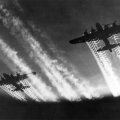
One hell of a photographer. :scared:

He's definitely got some nerves to be right in the middle of a battle taking a picture of Rudolph. Then again, he is Russian....


USS New Jersey (BB-62) firing all 16" guns simultaneously - 1986. I've been on this ship before and I wouldn't want to be anywhere near this thing when the guns go off. That thing is 🤬 massive. One of the world's biggest.

IHSOb.jpg
 
Very cool and interesting location 👍
 
Those ring shapes are awesome. Not an ideal substitute for real hair though. :lol:


OK2zd.jpg


QXlAF.jpg
 
Sorry for the small size, but this is just awesome.

2sK0i.png

The angle of both rear wings reminds me of this... The lockheed XFV-1, a vertical takeoff aircraft from the early 1950s.
Lockheed_XFV-1_Salmon_in_flight.jpg

Lockheed_XFV-1_Salmon_upright.jpg
 
^Oh yeah, forgot about that thing for a second. Such a cool concept.


This is how much bigger bombers got over the course of about 7 years. They call the one on the right the "Peacemaker" :lol:

SuBUT.jpg
 
Hammond you idiot, you've put the engines on backwards! :sly:
 
578845_372937086111164_332596609_n.jpg
 
There is something very unusual in this picture of the Earth -- can you find it? A fleeting phenomenon once thought to be only a legend has been newly caught if you know just where to look. The above image was taken from the orbiting International Space Station (ISS) in late April and shows familiar ISS solar panels on the far left and part of a robotic arm to the far right. The rarely imaged phenomenon is known as a red sprite and it can be seen, albeit faintly, just over the bright area on the image right. This bright area and the red sprite are different types of lightning, with the white flash the more typical type. Although sprites have been reported anecdotally for as long as 300 years, they were first caught on film in 1989 -- by accident. Much remains unknown about sprites including how they occur, their effect on the atmospheric global electric circuit, and if they are somehow related to other upper atmospheric lightning phenomena such as blue jets or terrestrial gamma flashes.
spritenight_iss_4256.jpg
 
Cool phenomenon!

[very cool and nice NASA photos won't show and I'm too lazy to upload]
 
Last edited:
@ Neal, Very interesting phenomena, and cool. 👍


Dtddh.jpg


wWP5y.jpg


Yes, that's soy sauce under a microscope (salt crystals, not nano-bots ;)).
 
551916_235592643230131_2136365061_n.jpg

Madeira Islands, Portugal
 
Any hi-rez of the above?
 
^Oh yeah, forgot about that thing for a second. Such a cool concept.


This is how much bigger bombers got over the course of about 7 years. They call the one on the right the "Peacemaker" :lol:

SuBUT.jpg

[offtopicsorryness]It flies!:


[/offtopicsorryness]
 
Six turning, four burning. :D

And a glowing crew...
 
Those mountains aren't anywhere near being on the same scale as eachother, plus there are dozens of locations here on Earth that bear a resemblance to places on Mars. I just thought it was an interesting coincidence.
 
The photo of Mars is also color-timed to look more like formations here. Apparently done for the geologists to get a better idea of the strata layers on the mountains.

At the end of the day, though, Mars is still a rocky planet just like Earth. Aside from life, the only thing it's really missing is water. So it's not surprising that they would look very similar if you could find a similar environment here on Earth (and there's no shortage of different environments here).
 
Those mountains aren't anywhere near being on the same scale as eachother, plus there are dozens of locations here on Earth that bear a resemblance to places on Mars. I just thought it was an interesting coincidence.

I was talking about whoever made the photo.
 
Large image warning [2560x1440]

On August 31, 2012 a long filament of solar material that had been hovering in the sun's atmosphere, the corona, erupted out into space... Four images of the filament on the sun are shown here in various wavelengths of light as captured by NASA’s Solar Dynamics Observatory (SDO). Starting from the upper left and going clockwise they represent light in the: 335, 171, 304 and 131 Angstrom wavelengths. Since each wavelength of light generally corresponds to solar material at a particular temperature, scientists can compare images like this to observe how the material moves during an eruption.
...Full story

fourpanel.jpg
 
Back