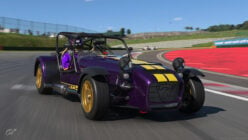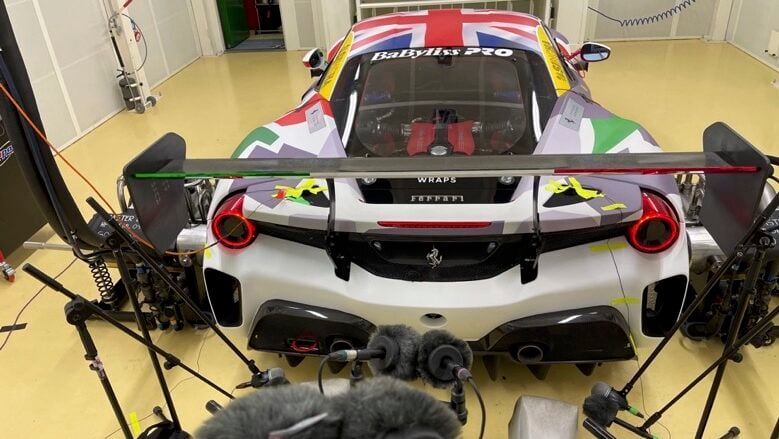
Although the situation has improved in recent iterations, for much of its history the Gran Turismo series has been heavily criticized for its engine sounds. During the PlayStation 2 and 3 eras, engine notes were often compared to “vacuum cleaners”; the result of synthesized loops that lacked the soul and mechanical violence of their real-world counterparts.
That narrative finally began to shift with Gran Turismo Sport and Gran Turismo 7, and the Polyphony Digital audio team has previously shared an extensive look behind the scenes at how these advancements were actually made.
Nevertheless, there is still room for improvement. With GTPlanet in attendance during a round-table interview at the 2025 GT World Series Finals in Fukuoka, Japan, series creator Kazunori Yamauchi revealed what he wants to do next.
The History of GT Engine Sounds
To understand Yamauchi’s latest comments, we need to look back at how far the series has come.
In a 2012 interview with GTPlanet, Yamauchi made a somewhat controversial claim: he felt the sounds in GT5 were actually “too real”. At the time, Polyphony was recording cars on dynamometers under load, producing highly accurate, yet flat, recordings. Yamauchi admitted then that the team needed to “design” the sound to make it “sexier”.
By the time GT Sport arrived in 2017, the philosophy had shifted yet again. The breakthrough was moving away from simple compressors and equalizers to focus on the “human touch”, identifying specific elements the human ear tunes into and boosting them to create immersion.

Volume and Sound Pressure
In this latest interview, Yamauchi-san’s comments took a more scientific turn, pivoting toward the physics of human perception.
“The biggest issue is actually the volume,” Yamauchi explained. “The human ear has an optimum level for picking up the character of a sound, which is around 86 decibels. When you drop three decibels at a time from that level, the allure of the sound just keeps dropping.”
This is a reference to something audio engineers frequently refer to as “Fletcher-Munson curves,” or equal-loudness contours. At the 86 dB+ levels of a real race car, the human ear perceives bass more prominently, and the sound itself can feel more intense and immersive, sometimes even as a physical sensation. Most home players listen to the game at 60-70 dB.
At these lower volumes, the ear loses sensitivity to low and high frequencies, making the engine sound “smaller” and less impactful than it actually is.
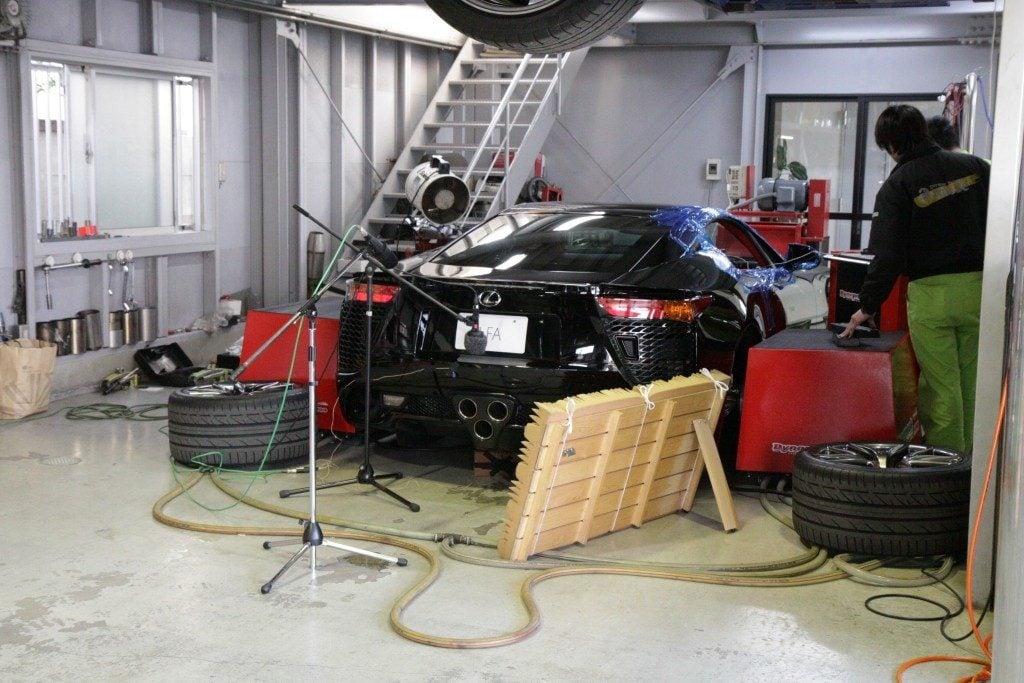
Resonance and Overlap
Yamauchi-san isn’t just blaming your crappy TV speakers, though. He admitted that the internal complexity of the game’s audio engine still needs to evolve to match the chaotic resonance of a real car’s chassis.
“When you have a car, various components are vibrating in different parts and resonating with the chassis,” Yamauchi noted. “They are coming from different places and resonating with each other. We try to recreate this using impulse resonance and overlapping sounds, but I do think we need to overlap even more sound sources to get it right.”
Currently, GT7 uses a mix of engine, intake, exhaust, and transmission whines. Yamauchi’s vision for the future involves a more granular approach, simulating the micro-vibrations of individual engine components to create a more “organic” output.
Faking It
Perhaps most tellingly, Yamauchi spoke about the “temptation” to fake the experience. Many modern racing titles “decorate” their audio, adding artificial bass boosts or exaggerated pops and bangs to make the cars sound more “cinematic.” For Yamauchi, this is a line he is hesitant to cross.
“One thing I am divided on is that you can ‘decorate’ the sound, but when you do that, you start straying away from what that car actually sounds like.”
This reaffirms Polyphony’s often “purist” philosophy. While other titles might prioritize the “feeling” of speed through exaggerated audio, Gran Turismo remains obsessed with the reality of the machine, even if that reality is hampered by the limitations of home audio equipment.
At this point in Gran Turismo 7’s life cycle, it is likely we won’t see any significant changes to Gran Turismo audio until GT8 comes around. Yamauchi’s comments suggest that the next frontier isn’t just “better samples” or artificial decoration, but better mixing and sound layering.
See more articles on Audio and Kazunori Yamauchi.