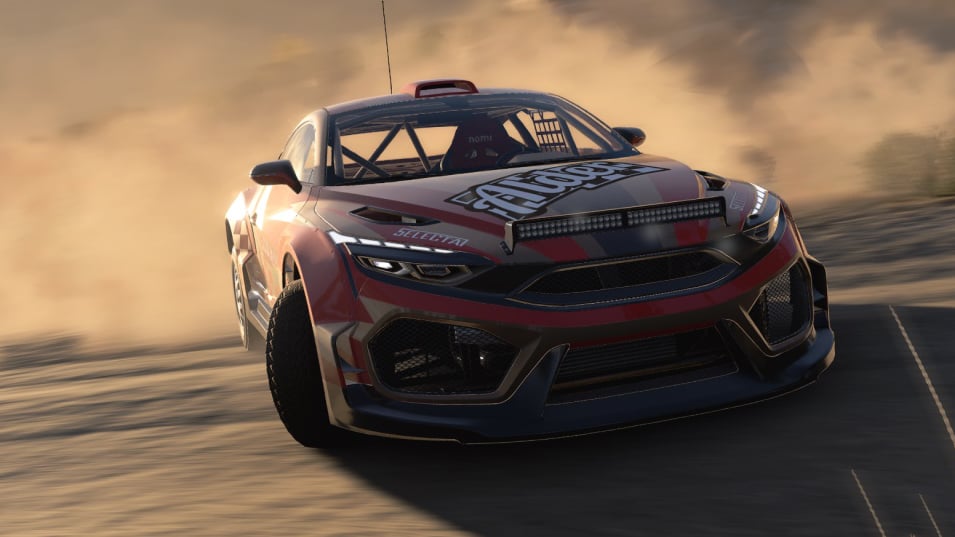
BeamNG.drive’s latest update contains something quite interesting buried in its graphics overhaul: the game now renders its final image using tone mapping technology developed by Polyphony Digital for Gran Turismo 7.
The developers explicitly credit Gran Turismo 7 in their documentation while linking directly to Polyphony Digital’s presentation and code, where it was spotted by GTPlanet user nolifebr and posted in our forums.
Version 0.39, released on July 29 and described by BeamNG as the biggest update in the game’s history, replaces its previous ACES-based tone mapper (derived from the film industry’s widely used Academy Color Encoding System) with what the studio’s official documentation plainly calls “a Gran Turismo 7 tone mapping”.
That should be familiar to long-time GTPlanet readers: it’s the same “Driving Toward Reality” talk delivered by three Polyphony engineers at SIGGRAPH 2025, which we covered in detail in our article “Why Gran Turismo 7’s Graphics Look So Different From Other Games“.
Alongside the slides, Polyphony published a standalone C++ sample implementation of the GT7 tone-mapping operator under the MIT License, effectively inviting other developers to study and use it.
Less than a year later, one of them has.
Polyphony Digital has a long history of presenting its research at academic conferences like SIGGRAPH and CEDEC, but seeing another commercial game adopt that work (and openly say so) is notable.
The timing is fitting, as Polyphony’s HDR work has been in the spotlight again lately.
Just last weekend, we covered the studio’s “Beyond HDR” presentation at CEDEC, where GT7 was demonstrated on a prototype Sony display sustaining more than 10,000 nits. The same engineers behind that session (Kenichiro Yasutomi, Kentaro Suzuki, and Hajime Uchimura) were the presenters of the SIGGRAPH talk whose work now lives inside BeamNG.
Of course, BeamNG.drive is coming to PlayStation 5 in 2026. When it arrives, it will be rendering its image with Gran Turismo technology, on Gran Turismo’s home console.
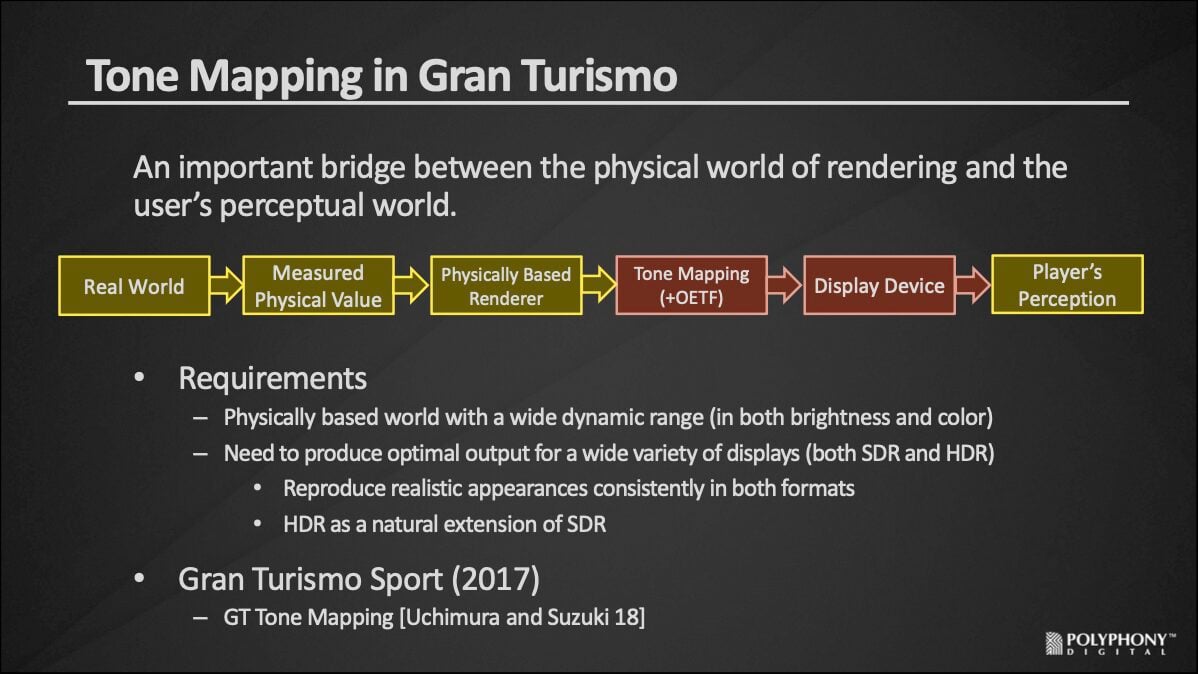
What Tone Mapping Actually Does
If you’ve never heard the term before, tone mapping translates the enormous range of brightness and color produced by a game’s renderer into the smaller range a display can actually reproduce.
A game engine like BeamNG’s (or GT7’s) calculates lighting internally using real-world values, where the sun is tens of thousands of times brighter than a shaded wall. No television can show that, so tone mapping is one of the final steps in forming the image. It compresses all of that light into something that looks natural on your display, whether that’s an old SDR monitor or a modern HDR TV.
How the GT7 Method Works
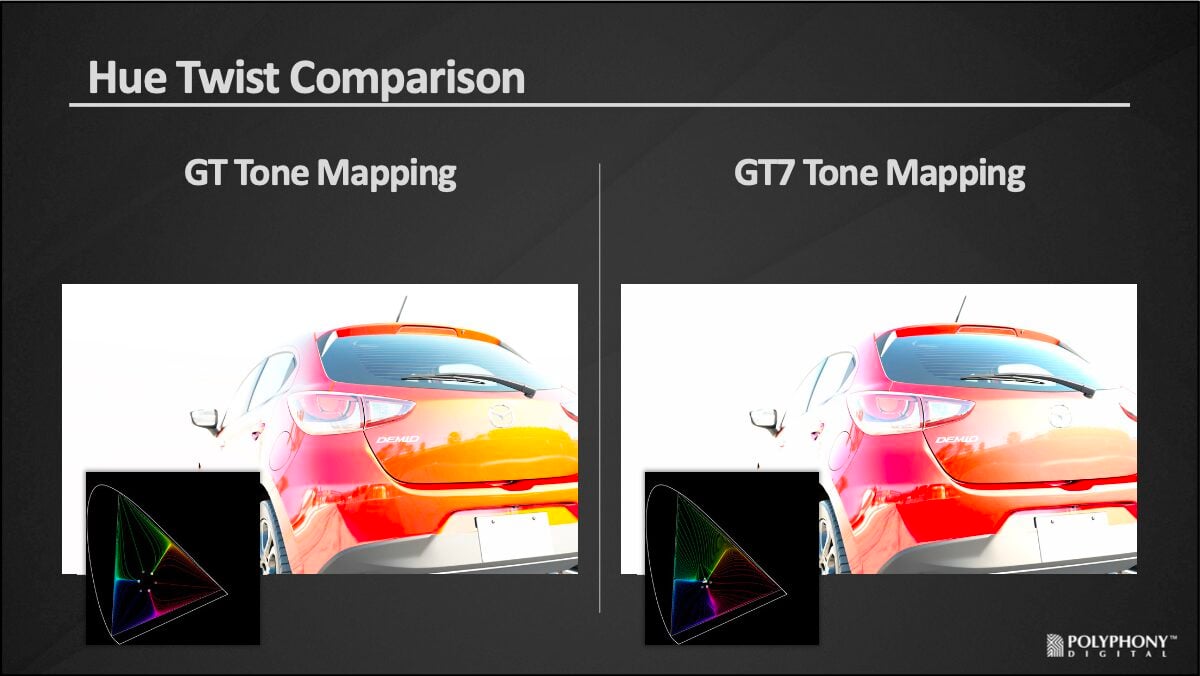
Polyphony’s approach is built around a simple idea: handle brightness and color separately, so that adjusting one doesn’t ruin the other.
The system converts the image into a special format modeled on human vision, where a pixel’s brightness and its color are stored independently. That allows it to preserve the identity of saturated colors much more effectively as brightness rises. A red brake light is far less likely to drift toward orange, although the very brightest colors are still gradually desaturated as they approach the display’s limit.
From there, a couple of finishing touches shape the final image. Polyphony blends a controlled amount of the conventional per-channel result back in, retaining some of the camera-like color response viewers are accustomed to. And the curve uses a highlight “shoulder” to roll intense values off toward the display’s peak, retaining more gradation in bright areas before the output eventually reaches its hard limit.
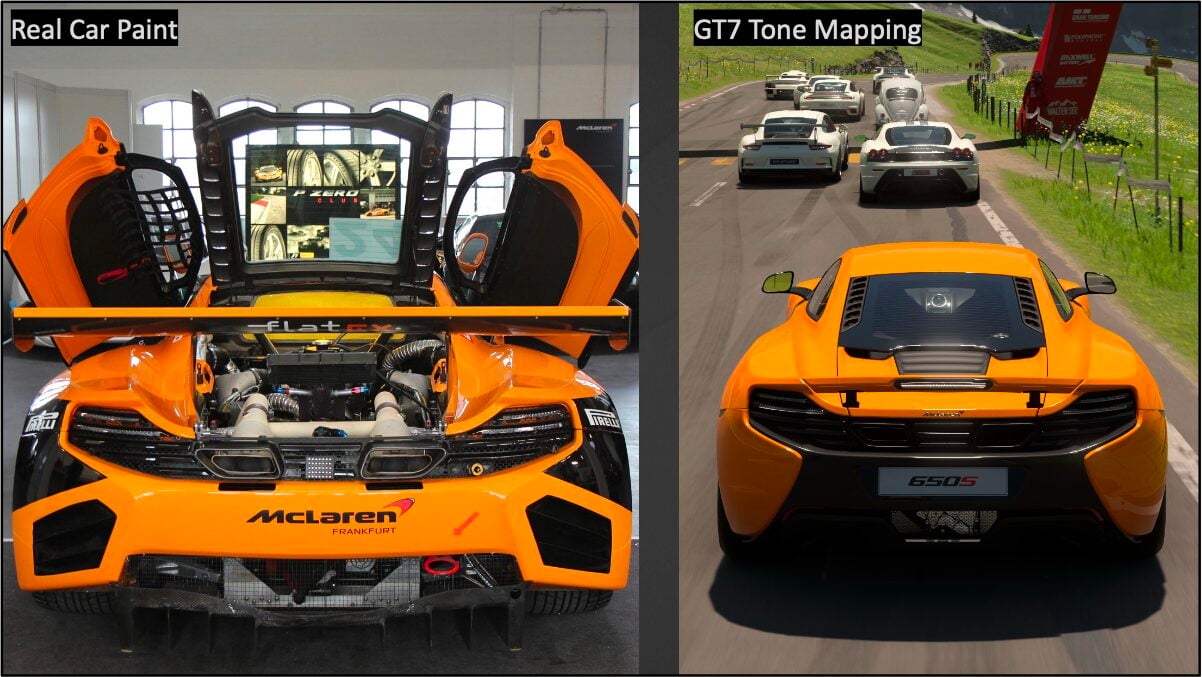
The practical payoff, and a benefit BeamNG highlights in its own documentation, is consistency.
The GT7 tone mapper produces a closely matched overall appearance across SDR and HDR, while allowing HDR displays to retain brighter highlights and a wider contrast range, adapting its curve to the output mode and display brightness it’s configured for.
Artists can author lighting once using physical values, while BeamNG’s exposure, tone mapping, and output pipeline translates that lighting correctly across SDR and HDR displays. The documentation makes this explicit, telling game modders to always use real-world values and to stop compensating for the limits of SDR screens.
Alongside the new tone mapper, version 0.39 also adds HDR10 and scRGB output to BeamNG.drive for the first time, along with a physically correct light falloff model. Anyone who has followed Polyphony’s decade-long HDR crusade will recognize the whole philosophy: build the lighting correctly, and let the display technology catch up.
Polyphony Digital has always positioned its conference presentations as contributions to the wider graphics community, and BeamNG’s adoption is the clearest proof yet that community is paying attention.
Now we just need to get Polyphony Digital to use BeamNG’s damage model…
See more articles on BeamNG and Polyphony Digital.